
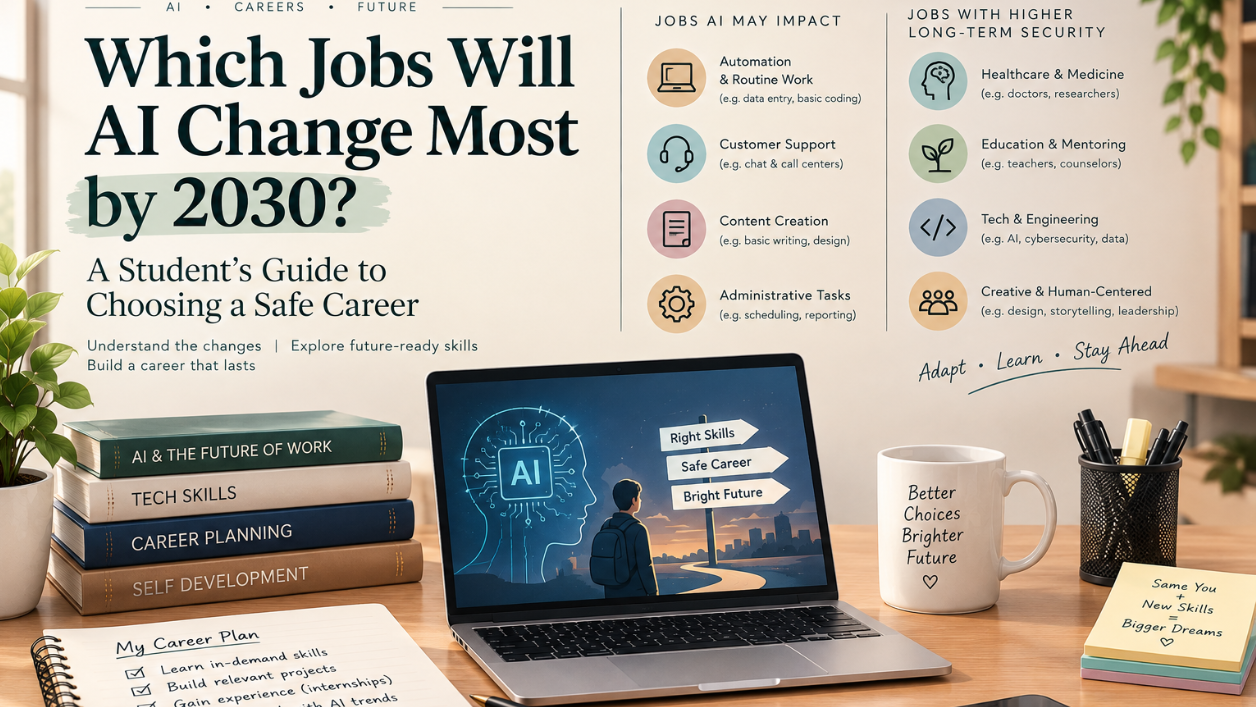
If you are choosing a degree or planning your first job, you have probably seen two very different headlines. One says AI will take millions of jobs. The other says AI will create more jobs than it destroys. Both are partly true, which is why the topic feels so confusing.
This guide sets out what research from the World Economic Forum, the International Labour Organization, Stanford University and Microsoft actually shows about which jobs AI is changing, which jobs are growing, and how you can choose a career path with fewer regrets.
The Short Version
- AI is changing tasks more than it is deleting whole jobs. Most jobs are a bundle of tasks, and AI can already do some of them.
- Jobs built mainly from routine, digital, information-processing tasks are changing fastest. Examples include clerical work, data entry, customer service, routine writing and translation, and entry-level coding.
- Jobs that need physical presence, hands-on skill, care, trust and real-time judgment are more resilient, and several of them are among the biggest growth areas.
- Young workers in exposed occupations are feeling the effect first, mostly through fewer entry-level openings.
- No job is completely AI-proof. The safest position is to be the person in your field who uses AI well.
"Exposed" Does Not Mean "Replaced"
Many headlines confuse exposure with job loss. A job is "exposed" when AI can do some of its tasks. That is very different from AI doing the whole job.
The International Labour Organization (ILO) estimates that around one in four workers worldwide are in an occupation with some exposure to generative AI, but only about 3.3 percent of global employment falls into the highest exposure category. Its conclusion is that transforming jobs is a more likely result than replacing them, because most occupations still contain tasks that need human input.
Microsoft Research reached a similar conclusion when it analysed how people use AI at work. Its researchers said AI supports many tasks, especially research, writing and communication, but the data does not show that AI can fully perform any single occupation.
What the Research Says
World Economic Forum: Future of Jobs Report 2025
- Employers surveyed expect 170 million new jobs to be created and 92 million to be displaced by 2030, a net gain of 78 million. These figures reflect several forces together, including technology, the economy, demographics and the green transition, not AI alone.
- The fastest-declining roles include postal service clerks, bank tellers and data entry clerks. The biggest overall declines are expected among cashiers and ticket clerks, administrative assistants and executive secretaries, and building caretakers, cleaners and housekeepers.
- The largest growth in numbers is expected among frontline roles such as farmworkers, delivery drivers, construction workers, salespeople and food processing workers. Care jobs such as nurses, social workers and counsellors, and personal care aides are also expected to grow, along with secondary and higher education teachers.
- About 41 percent of employers plan to reduce their workforce where AI can automate tasks, while almost half expect to move staff from exposed roles into other parts of the business.
- AI and big data, networks and cybersecurity, and technological literacy are the three fastest-growing skills.
International Labour Organization: 2025 Global Index
- Clerical occupations show the highest exposure. Data entry clerks, payroll clerks and typists have the highest automation potential.
- Exposure is higher in richer economies, at around 34 percent of jobs in high-income countries compared with 11 percent in low-income countries, largely because richer economies have more office-based work. That gap may narrow as more work becomes digital.
- In high-income countries, women's employment is more exposed than men's, partly because more women work in clerical and administrative roles.
Microsoft Research: Working with AI (2025)
- The occupations with the highest AI applicability included interpreters and translators, historians, passenger attendants, sales representatives of services, writers and authors, customer service representatives, telephone operators, and ticket agents and travel clerks.
- The occupations with the lowest applicability were mostly hands-on roles, such as pile driver operators, orderlies, floor finishers, rail-track maintenance operators, nursing assistants and phlebotomists.
Stanford Digital Economy Lab: Canaries in the Coal Mine (August 2026 update)
- Using US payroll data, researchers found that employment among workers aged 22 to 25 in highly AI-exposed occupations is about 19 percent below where it would be if it had kept pace with young workers in less-exposed jobs. A year earlier the gap was 15 percent.
- They found no widespread, economy-wide job displacement. The adjustment appears to happen mainly through companies hiring fewer young workers, not through mass layoffs.
- Declines are concentrated in occupations where AI tends to automate tasks. Where AI mainly complements workers, employment is flat or rising, especially for experienced workers.
- Software development and customer service are among the examples of exposed occupations with large declines for early-career workers.
The researchers describe these findings as early, descriptive signals rather than proof of cause, and they are based on US data.
The Jobs Changing the Most
1. Clerical and administrative work
Data entry, payroll processing, typing, scheduling and routine paperwork are the most exposed tasks in almost every study. Banking counter work and postal clerical roles are also expected to shrink. What stays human is handling exceptions, dealing with people, and taking responsibility for decisions. If you are heading into administration, aim for roles that combine coordination, judgment and people skills, and learn the AI and automation tools that are taking over the routine part.
2. Customer service and call centres
Customer service representatives appear near the top of Microsoft's exposure ranking, and Stanford's data shows large declines for early-career workers in this occupation. AI handles routine questions well. Humans are still needed for complex, emotional or high-value cases. Build skills in problem-solving, negotiation and communication, and consider moving toward customer success, account management or support for complex products.
3. Writing, editing and translation
Writers, editors, proofreaders and translators score high on AI applicability because AI is already good at drafting, summarising and language conversion. The work that remains valuable is original reporting, expert insight, a distinct voice, cultural judgment and accountability for accuracy. Specialise in a subject area, and use AI for speed while you provide the thinking and the fact-checking.
4. Entry-level software development and web work
The picture here is mixed. Software developers are among the roles expected to see large growth in numbers, yet Stanford finds that early-career software developers have seen large employment declines. AI now handles much of the boilerplate and routine coding that used to train junior developers. Students should treat AI coding tools as essential, build real projects, and develop skills that AI cannot easily replace, such as system design, debugging, security, and understanding what users actually need.
5. Research, analysis and sales support
Market research analysts, sales representatives of services and similar roles use a lot of information gathering and communication, which AI supports well. The strongest people in these fields combine AI-assisted speed with sound judgment about what the numbers mean and what to do next.
The Jobs Growing or More Resilient
- Health and care. Nurses, personal care aides, social workers and counsellors are expected to grow, and hands-on healthcare support roles rank low on AI applicability. Trust, empathy and physical presence are hard to automate.
- Education. Secondary and higher education teachers are expected to see growth, as demand for skills training rises.
- Skilled trades and frontline work. Construction, electrical work, agriculture and delivery are expected to add many jobs, and manual and equipment-operating roles are among the least exposed to generative AI.
- Tech roles that build, secure and manage AI. AI, data, networks and cybersecurity skills are among the fastest-growing skills worldwide.
A few cautions apply. Resilient does not mean unchanged, because nurses, teachers and tradespeople will also use AI tools. Some frontline jobs are growing in numbers but may offer lower pay or harder conditions. And forecasts are uncertain, so treat these lists as guidance rather than guarantees.
Why Headlines Can Mislead You
- "92 million jobs lost to AI" is a misreading. The WEF figure covers several economic forces, and it is paired with 170 million new jobs.
- "At risk" usually means "some tasks can be done by AI", not "this job will disappear".
- Most studies rely on estimates and assumptions. The ILO, for example, lowered many task-level scores in its 2025 update after learning how people actually use AI tools.
- Results differ by country. Exposure looks lower in poorer economies partly because fewer people do digital office work, which may change over time.
How to Choose a Safer Career: Five Questions
1. How much of the job is routine, digital and rule-based? The higher the share, the faster the job will change.
2. Does it need physical presence or hands-on skill? Work in unpredictable physical environments is harder to automate.
3. Does it depend on trust, empathy or accountability? People still want a human to be responsible in medicine, teaching, law, counselling and leadership.
4. Will AI complement the worker or substitute for them? Stanford's data suggests roles where AI complements workers hold up better than roles where it replaces tasks.
5. Is there still a path from junior to senior? If companies stop hiring juniors, you need another route in, such as internships, apprenticeships, projects and networking.
A useful exercise: list the ten main tasks of a job you are considering, then mark which ones AI can already do well. If most of them are marked, learn how to supervise and improve AI in that work, or consider a related role with more human contact.
Skills That Keep Their Value
The WEF's employer survey highlights analytical thinking, resilience and flexibility, leadership and social influence, creative thinking, and curiosity and lifelong learning as skills that are rising in importance. Alongside them, AI and data skills, cybersecurity and general technological literacy are the fastest-growing technical skills.
- Human skills: critical thinking, communication, empathy, teamwork, leadership and ethical judgment.
- AI skills: using AI tools well, checking their output, working with data, and knowing where not to use AI.
- Learning skills: the ability to pick up new tools quickly, because around two-fifths of core job skills are expected to change by 2030.
A Student Action Plan
- If you are choosing a degree: Pick a field you can commit to, then check how the daily tasks in that career are changing. Look for programmes that include practical projects, internships and AI skills.
- If you are already studying: Learn to use AI tools in your own subject, build two or three real projects, and get work experience early, since entry-level hiring is where the pressure is showing up.
- If you are a fresh graduate: Target roles where AI is a tool you use rather than a replacement for your tasks, and show evidence of your skills through a portfolio.
- If your dream job is exposed: Do not give up on it. Specialise, build a strong portfolio, and aim to become the person who manages and improves AI-assisted work.
A simple 90-day plan
1. Days 1 to 30: Choose three target roles. For each, list the main tasks and note which ones AI can already do.
2. Days 31 to 60: Learn the AI tools used in those roles and complete one project that shows you can use them well.
3. Days 61 to 90: Publish your portfolio, update your CV and LinkedIn profile, and apply for internships or entry-level roles. Speak to two or three professionals in the field about how their work is changing.
Common Myths
- "AI will take all jobs." The evidence shows job transformation and some entry-level pressure, not mass unemployment.
- "My degree keeps me safe." Degrees still matter, but employers increasingly look for practical skills and proof of what you can do.
- "Learn to code and you are safe." Coding is changing fast, and junior coding tasks are among the most exposed. Deeper skills matter more.
- "Trades and care jobs are immune." They are more resilient, but they are also changing, and pay and working conditions vary.
Frequently Asked Questions
Which jobs are safest from AI?
Hands-on, care-based and trust-based jobs, such as nursing, teaching, skilled trades and counselling, are generally more resilient. No job is completely safe, so keep learning.
Should I avoid degrees in fields like writing, coding or customer service?
Not necessarily. These fields are changing, not disappearing. If you choose one, plan to specialise, use AI tools and build a strong portfolio.
Will AI create new jobs?
Yes. The WEF expects 170 million new jobs by 2030, including in technology, data and AI. However, new jobs may need different skills, and the transition will not be equal for everyone.
Is it too late to change my career plans?
No. These changes are unfolding over several years, which gives you time to adapt your skills and choices, although starting early helps.
How do I know if my chosen career is at risk?
Look at how much of the work is routine and digital, whether AI complements or replaces its tasks, and what professionals in the field say about hiring. Then plan your skills around the answer.
Final Thoughts
AI is not ending work, but it is changing which tasks people do and how new workers get started. The students who will do best are not necessarily those who pick the "safest" job on a list. They are the ones who understand how their chosen field is changing, build both human and AI skills, and can show real evidence of what they can do. Start early, stay curious, and keep adjusting as the technology and the job market evolve.
Sources and Further Reading
- World Economic Forum, Future of Jobs Report 2025: weforum.org/publications/the-future-of-jobs-report-2025
- International Labour Organization, Generative AI and Jobs: A Refined Global Index of Occupational Exposure (2025): ilo.org/publications/generative-ai-and-jobs-refined-global-index-occupational-exposure
- Microsoft Research, Working with AI: Measuring the Applicability of Generative AI to Occupations (2025): microsoft.com/en-us/research/publication/working-with-ai-measuring-the-occupational-implications-of-generative-ai
- Stanford Digital Economy Lab, Canaries in the Coal Mine? Six Facts About the Recent Employment Effects of Artificial Intelligence (August 2026 update): digitaleconomy.stanford.edu
---