
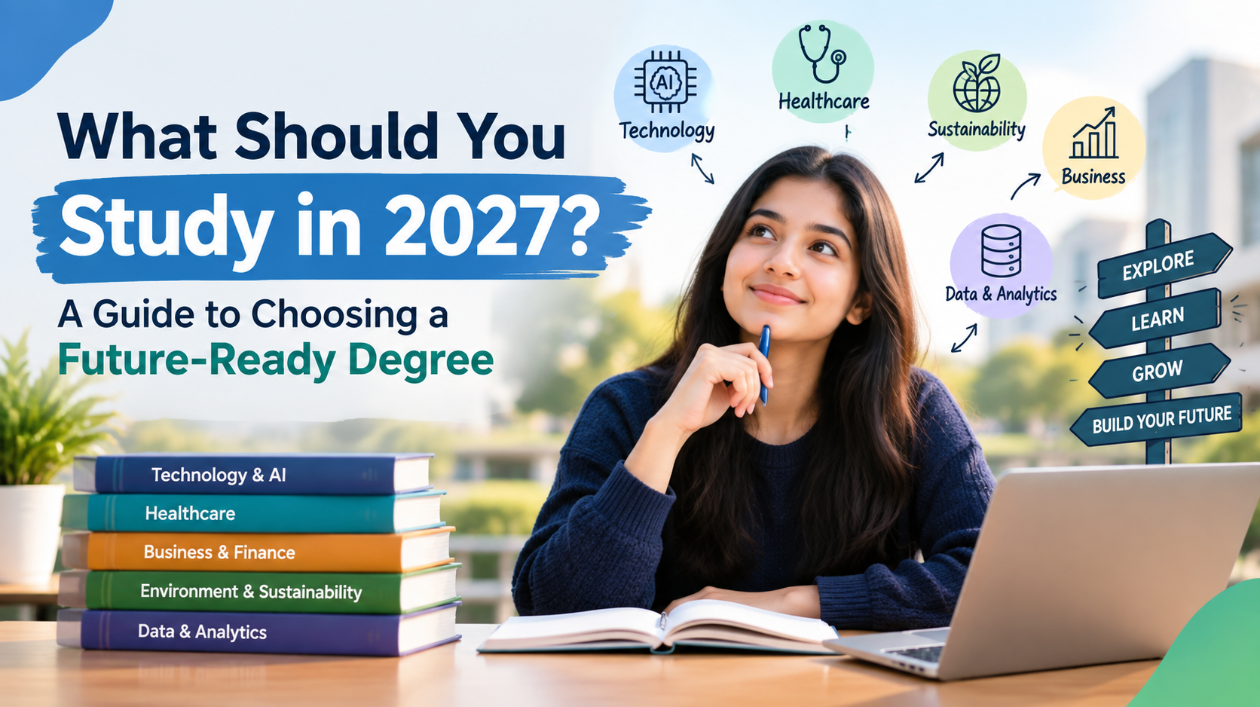
WHAT SHOULD YOU STUDY IN 2027? A GUIDE TO CHOOSING A FUTURE-READY DEGREE
Choosing a university degree is one of the biggest decisions a student makes. It can influence the skills they develop, the careers they explore, and the opportunities they find after graduation.
But choosing a degree in 2027 is not simply about asking, “Which degree has the highest salary?” Technology, artificial intelligence, cybersecurity, data, healthcare, and sustainability are changing the skills employers need.
This does not mean every student should choose a technology degree. Instead, students should look for fields that match their interests while also giving them useful skills, practical experience, and the ability to adapt to change.
So, what should you study in 2027?
1. Start With Your Interests and Strengths
Before choosing a future-ready career, start by understanding yourself.
Think about the subjects you enjoy, the problems you like solving, and the type of work you find interesting. A student who enjoys technology and mathematics may explore computer science or data science, while someone interested in healthcare may consider medicine, nursing, or biotechnology.
Choosing a degree only because it is currently popular may not always be the right decision. Your interests and strengths should also be part of the decision.
2. Consider Technology and AI
Artificial intelligence and technology are becoming part of almost every industry. Students interested in technology can explore fields such as:
Computer Science
Software Engineering
Artificial Intelligence
Data Science
Information Technology
Cybersecurity
However, being future-ready is not simply about learning the latest AI tool. Students also need strong problem-solving, analytical, and critical-thinking skills.
Technology will continue to change, so understanding the fundamentals of your field can be just as important as learning current tools.
3. Explore Data and Analytical Fields
Data is increasingly being used by businesses, healthcare organisations, financial institutions, governments, and other industries to make decisions.
Students who enjoy mathematics, statistics, and problem-solving can consider fields such as Data Science, Statistics, Business Analytics, Economics, and Mathematics.
Learning how to analyse information, understand patterns, and interpret results can also be useful for students pursuing careers outside traditional data-related jobs.
4. Look at Healthcare and Sustainable Careers
Healthcare remains an important field for students interested in science and helping people. Medicine, Nursing, Pharmacy, Biotechnology, Public Health, and Biomedical Sciences are some areas students can explore.
At the same time, environmental challenges are creating interest in areas related to sustainability and renewable energy. Students interested in science, engineering, and the environment can consider Environmental Science, Environmental Engineering, Renewable Energy, and Sustainability.
The future of work will not be shaped by AI alone. Healthcare, environmental challenges, and sustainable development will also influence many careers.
5. Don't Ignore Business and Finance
A future-ready degree does not have to be related to technology.
Business, Finance, Accounting, Economics, Marketing, Supply Chain Management, and Entrepreneurship can still provide students with a range of career options.
However, business students can make their education more valuable by developing digital and analytical skills. For example, a marketing student can learn digital marketing and data analytics, while a finance student can develop financial modelling and technology skills.
Combining knowledge from different areas can help students adapt as the workplace changes.
6. Develop Skills Alongside Your Degree
A degree provides academic knowledge, but students should also develop skills that can be useful in different careers.
Important skills include:
Communication
Critical thinking
Creativity
Problem-solving
Teamwork
Leadership
Digital literacy
Adaptability
These skills can complement technical knowledge and help students handle new challenges throughout their careers.
7. Gain Practical Experience
University is not only about attending classes and passing exams. Students should also look for opportunities to apply what they learn.
Internships, university projects, research, competitions, volunteering, and freelance work can help students gain practical experience.
For example, a computer science student could build an application, while a marketing student could create a digital marketing project. Such experiences can help students understand how their knowledge can be applied outside the classroom.
8. Look Beyond the Degree Name
Two students can graduate with the same degree but have very different skills and experiences.
Employers may consider more than a degree title. Internships, projects, portfolios, certifications, communication skills, technical abilities, and practical experience can also be valuable.
Students should therefore ask themselves not only:
“Which degree should I choose?”
but also:
“What will I be able to do by the time I graduate?”
This can help them make a more informed university and career decision.
How to Choose a Future-Ready Degree
There is no single degree that can guarantee a successful career in 2027 or beyond.
Students should consider their interests, strengths, career goals, future industry trends, and the skills they can develop through their education.
A future-ready degree is not necessarily the newest or most popular degree. It is one that helps students build strong knowledge, practical abilities, digital awareness, and the confidence to continue learning as the world changes.
Your degree can open the door to a career, but the skills and experience you build alongside it can help you move forward.