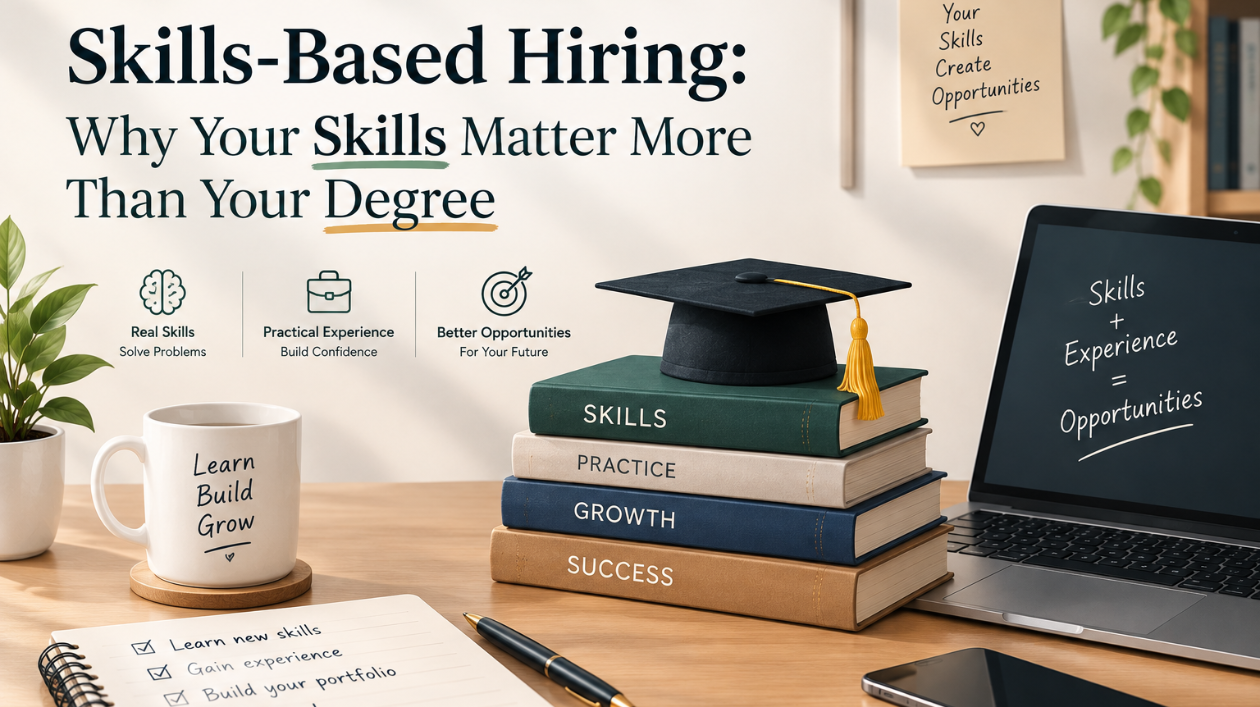
For years, the path to a good job looked simple: earn a degree, submit your CV and wait. Today, that path is changing. Employers around the world are paying closer attention to what candidates can actually do, not only where they studied or which degree they hold. This approach is called skills-based hiring, and it has important lessons for every student who is planning a career.
This guide explains what skills-based hiring means, what the data really shows, how it applies to Pakistani students, and how you can prove your skills even before you graduate.
What Is Skills-Based Hiring?
Skills-based hiring means employers evaluate candidates mainly on their demonstrated abilities, such as technical skills, problem-solving and communication, instead of relying only on degrees, university names or job titles. Recruiters may use practical tests, portfolio reviews, project tasks and structured interviews to check whether someone can do the job.
Large companies have moved in this direction. IBM, Google, Delta Air Lines and Bank of America, for example, have removed the four-year degree requirement from many of their roles.
Why Employers Are Shifting Toward Skills
Skills change faster than degrees. Technology and AI are transforming jobs quickly, and what a student learns in the first year of a degree may be outdated by graduation. Employers want people who can learn and apply current tools. According to NACE data reported in August 2026, more than a third of entry-level jobs now require some level of AI competency.
The talent pool gets bigger. LinkedIn research suggests that evaluating candidates by skills rather than job titles or degrees can expand the pool of eligible candidates by up to ten times. That helps employers find capable people from different backgrounds.
Employers want proof, not promises. A certificate or degree shows that you completed a course. A project, portfolio or work sample shows what you can produce.
What the Data Really Shows
The trend is real, but the full picture is more complicated than headlines suggest. NACE's Job Outlook 2026 reports that around 70 percent of employers say they use skills-based hiring, up from 65 percent the year before.
However, research from Harvard Business School and the Burning Glass Institute found a gap between announcements and actual hiring. Simply removing a degree requirement from a job posting rarely opens the job to people without degrees, and on average the change led to only a small increase (about 3.5 percent) in the number of non-degree workers. In other words, many companies have changed their job ads more than their hiring habits.
The lesson for students is clear. A degree still matters, but on its own it is not enough. Employers who genuinely hire for skills will notice candidates who can show real evidence of ability.
What This Means for Pakistani Students
The skills gap is a serious issue in Pakistan. Analysis by Gallup Pakistan of the Labour Force Survey 2024-25 shows that unemployment among graduates aged 20 to 24 is 32.8 percent, almost one in three. A 2025 study cited by Pakistan Education Review found that 72 percent of employers were dissatisfied with graduates' work-readiness, mainly because of gaps in practical experience, digital literacy and soft skills rather than technical subject knowledge.
This does not mean degrees are useless. Many government jobs, regulated professions such as medicine, law and engineering, and scholarship and postgraduate applications still require specific degrees. But in many private-sector fields, including IT, digital marketing, design, content, data and freelancing, employers and clients care a great deal about what you can show them.
A useful way to think about it: your degree opens the door, and your skills decide whether you walk through it.
Skills Employers Look For
Technical and role-specific skills. These depend on your field, such as coding, data analysis, accounting software, design tools, digital marketing or laboratory techniques.
Digital and AI skills. Using AI tools responsibly, working with data, and adapting to new software are becoming basic expectations in many jobs.
Soft skills. Communication, teamwork, time management, critical thinking and adaptability matter in every industry, and they are the skills AI is least able to replace.
How to Prove Your Skills Before You Graduate
1. Build a portfolio. Collect two or three strong projects that show your work, such as a website, a data dashboard, a design case study or a research report.
2. Use your final year project. Turn your FYP into a case study, publish the code on GitHub and add it to your LinkedIn profile.
3. Earn relevant certifications. Choose short, recognised courses, such as free government programmes like DigiSkills and NAVTTC, or HEC's free Coursera licences, and apply what you learn in real projects.
4. Take on real work. Internships, volunteer projects, society roles and small freelance jobs all count as evidence of skill.
5. Join competitions and hackathons. They give you results you can show and stories you can tell in interviews.
6. Showcase your work publicly. Update your LinkedIn profile, share what you learn, and connect with professionals in your field.
How to Write a Skills-Based CV
- Put a short skills section near the top, focusing on skills relevant to the job you are applying for.
- Describe achievements, not just duties. For example, "Built a student attendance app used by 120 classmates" says more than "worked on a project."
- Add links to your portfolio, GitHub or LinkedIn.
- Match your CV to the job description, using the same skill keywords where they honestly apply to you.
- List education clearly, but do not let it take up the whole page if you have projects to show.
A Simple 90-Day Plan
Days 1 to 30: Choose one target role and list the five most important skills it requires. Enrol in a free course for the skill you are weakest in.
Days 31 to 60: Build one project that uses those skills, and document what problem you solved and how.
Days 61 to 90: Publish your portfolio, update your CV and LinkedIn profile, and apply for internships or small freelance projects.
Mistakes to Avoid
- Collecting certificates without building anything. Certificates help, but projects prove more.
- Ignoring your degree. Keep your grades and academic requirements strong, especially if you want to apply for scholarships or postgraduate study.
- Listing every skill you have heard of. Employers value depth in a few relevant skills over a long list of unrelated ones.
- Claiming skills you cannot demonstrate. You may be asked to prove them in a test or interview.
- Waiting until your final semester. Start building evidence of your skills as early as possible.
Frequently Asked Questions
Do degrees still matter?
Yes. Degrees remain important for many jobs, government positions, regulated professions and higher education. Skills-based hiring means degrees are no longer the only thing employers look at.
Can I get a job without a degree in Pakistan?
In some fields, especially IT, freelancing, digital marketing and design, strong skills and a portfolio can open opportunities. Requirements vary widely by employer and industry, so check what your target roles ask for.
What is the fastest way to build job-ready skills?
Choose one skill, take a structured course, build two or three real projects, and publish them. Free programmes like DigiSkills, NAVTTC and HEC's Coursera licences can help you start.
Final Thoughts
The job market is rewarding people who can show what they know and what they can do. A degree remains a valuable foundation, but the students who stand out will be those who add practical skills, real projects and clear proof of their abilities. Start building your evidence now, and let your work speak for you.
---