
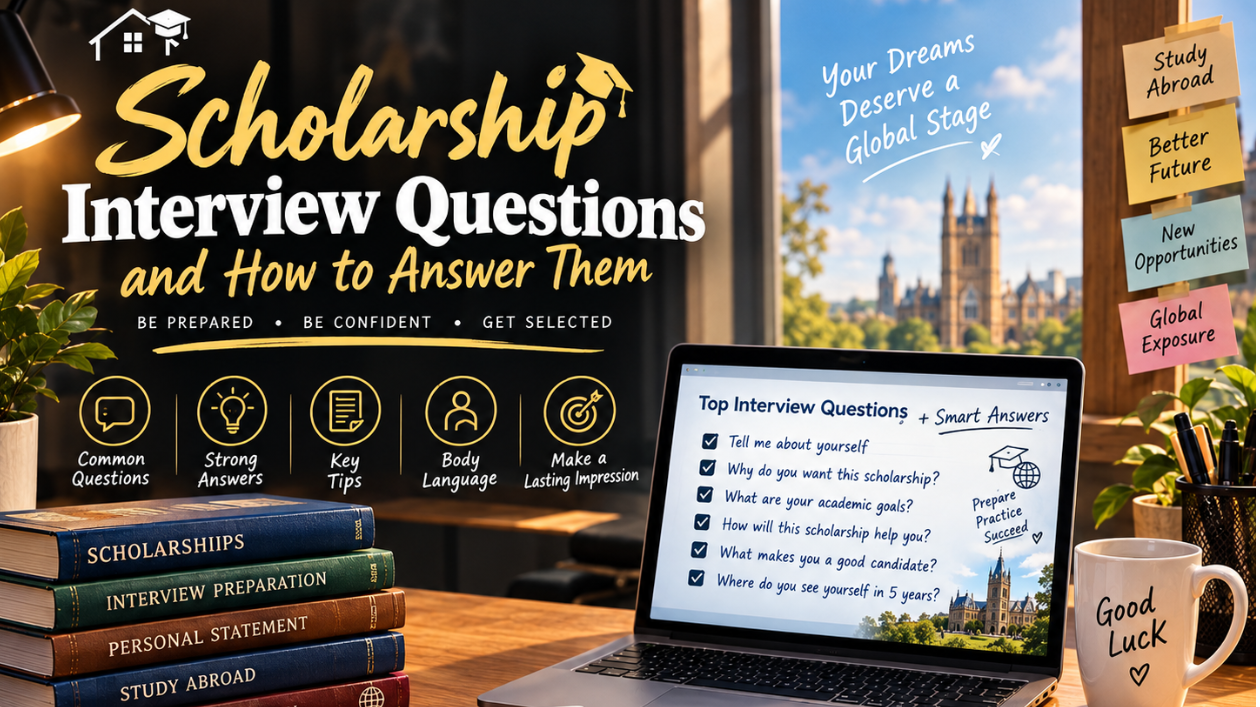
Being invited to a scholarship interview is good news. It means your written application has already convinced the reviewers, and now they want to meet the person behind it. The interview is where many strong candidates are separated, not because the others are more talented, but because they explain their goals and experiences more clearly and honestly.
This guide explains how scholarship interviews work, the questions you are most likely to be asked, how to answer them using a simple structure, and the mistakes to avoid. It includes sample answers you can adapt to your own story.
What Scholarship Panels Really Want
Whatever the scholarship, interviewers are usually trying to answer five questions about you:
- Are your goals clear and realistic?
- Do you have real evidence of leadership, achievement or impact?
- Are you the same person your application describes?
- Do you fit the values and purpose of this scholarship?
- Will you cope well with studying in a new country and come back to use what you learn?
Every question you hear is a different way of asking one of these five. Keeping them in mind helps you answer even a question you did not prepare for.
How Scholarship Interviews Work
The format depends on the scholarship, so always read the official interview guidance. Some examples:
Competency-based panel interviews. The Chevening interview, for example, is a competency-based panel assessment conducted in English, with representatives of the British embassy or high commission on the panel. Shortlisted candidates must upload their supporting documents, such as ID, certificates and reference letters, at least seven working days before the interview, and interview slots are given on a first-come, first-served basis. Interview lengths vary by country, so check your invitation.
Panels of embassy, commission and academic representatives. Fulbright interviews, where they are held, often last around 15 to 30 minutes depending on the country. Panels look at your academic fit, leadership, readiness for cultural exchange and your plans after returning home. Official Fulbright guidance encourages candidates not to try to over-impress, but to be themselves and focus on their goals.
Interviews after a test. For Türkiye Scholarships, undergraduate candidates take a 30-question quantitative test covering mathematics, geometry and logic before the face-to-face interviews with the selection delegations. Interviews may take place in your country or online, sometimes with short notice, so keep your documents and preparation ready.
Some scholarships do not interview everyone. Many programmes select candidates from documents alone, or only interview a final shortlist. Always check the official selection process for the scholarship you applied to.
Online interviews are increasingly common. Test your internet connection, camera and microphone, choose a quiet room with a plain background, and keep your documents nearby.
How to Prepare
1. Re-read your application
Panels often build their questions directly from your essays, CV and references. Be ready to explain every example, date and claim in detail, and make sure your interview answers match what you wrote.
2. Research the scholarship
Learn its mission, values, history and what it says about its ideal candidate. Then prepare to show, with examples, that you fit that description.
3. Build a bank of stories
Prepare five or six real experiences that show leadership, teamwork, problem-solving, resilience, initiative and impact. One good story can answer several different questions.
4. Learn the STAR method
Structure each story in four parts:
- Situation: the context.
- Task: your responsibility or goal.
- Action: what you personally did.
- Result: what happened, ideally with a number or a clear outcome, and what you learned.
5. Practise out loud
Answers that sound good in your head often come out messy. Aim for answers of about one to two minutes, so there is time for follow-up questions.
6. Run a mock interview
Ask two or three people, ideally including someone who has been through the process, to interview you and interrupt with follow-up questions. Record yourself if you can.
7. Prepare questions for the panel
When they ask "Do you have any questions for us?", have one or two thoughtful questions ready, for example about alumni networks or opportunities during the programme.
Common Scholarship Interview Questions and How to Answer Them
About You
1. "Tell me about yourself."
What they test: clarity and focus.
How to answer: Do not recite your CV. In about two minutes, describe your background, what led you to your field, one or two key achievements, and what you want to do next. Close by connecting to the scholarship.
Example: "I grew up in a small town, where I noticed how few students had access to reliable science labs. That pushed me toward a degree in environmental engineering, and during my final year I led a team that designed a low-cost water testing kit now used in three local schools. I want to deepen my expertise in water systems through this master's so I can scale that work across my region."
2. "Why do you deserve this scholarship?"
What they test: self-awareness and fit, not arrogance.
How to answer: Avoid saying you are the best. Explain what you bring, what you will gain, and how the scholarship will multiply your impact.
Example: "I have a record of turning ideas into results, and I know exactly what I am missing to go further. This scholarship would give me the training and network to expand a project that already helps students, and I am committed to sharing what I learn when I return."
3. "What are your strengths and weaknesses?"
What they test: honesty and growth.
How to answer: Choose real strengths and back them with evidence. For weaknesses, avoid clichés such as "I work too hard". Pick a real one, and show what you are doing to improve.
Example: "I tend to take on too much myself. I learned this when a project deadline slipped, so now I write clear task lists, delegate early and check in weekly. On my last project, that helped us finish two days early."
Leadership and Impact
4. "Tell me about a time you led a team or influenced others."
What they test: leadership evidence.
How to answer: Use STAR. Focus on what you did to motivate or influence people, not only your title.
Example: "As president of our university science society, attendance had fallen sharply (Situation). I was responsible for reviving it before the annual fair (Task). I surveyed members, changed the meeting format, and recruited ten volunteers to run workshops (Action). Attendance tripled within two months and the fair drew over 300 visitors (Result)."
5. "Tell me about a failure or a challenge and what you learned."
What they test: resilience and honesty.
How to answer: Choose a real setback, own your part in it, and spend more time on what you changed than on the failure itself.
6. "What is your biggest achievement?"
What they test: what you value and how you define success.
How to answer: Pick an achievement that shows the qualities the scholarship values, describe your specific contribution and the outcome, and mention what it changed for other people.
7. "How do you handle disagreement in a team?"
What they test: teamwork and communication.
How to answer: Describe a real example where you listened to the other side, found common ground and reached a decision, rather than saying you "never have conflicts".
Study Plan
8. "Why this course, this university and this country?"
What they test: research, commitment and a coherent plan.
How to answer: Mention specific modules, professors, research strengths or facilities, and explain how they connect to your goals. Generic praise such as "it is a world-class university" scores poorly.
9. "Why can't you study this in your home country?"
What they test: a genuine reason for studying abroad.
How to answer: Be respectful and specific. Explain what the programme offers that you cannot get locally, such as a specialisation, research facilities or industry links, without criticising your own country's institutions.
10. "What will you do if you don't get this scholarship?"
What they test: commitment and realism.
How to answer: Show that you have a Plan B, such as applying to other funding or working to save, while making clear that this scholarship is a strong priority and why.
Career and Impact
11. "Where do you see yourself in five and ten years?"
What they test: vision and realism.
How to answer: Give a clear, believable path with steps: what you will do after the degree, which role you will aim for, and what impact you will have. Avoid vague statements like "I want to change the world".
12. "How will you use what you learn when you return home?"
What they test: return on the scholarship's investment.
How to answer: Name specific actions, such as launching a programme, joining a policy team, training others or building a business, and explain who will benefit.
13. "How will you contribute to the scholarship community or alumni network?"
What they test: long-term engagement.
How to answer: Offer concrete ideas, such as mentoring future applicants, organising events or collaborating on projects in your field.
Adaptability and Values
14. "How will you adapt to living in a new country?"
What they test: cultural readiness.
How to answer: Share real experiences of adapting, such as travelling, studying or working with people from different backgrounds, and explain how you will handle challenges like homesickness or a new academic system.
15. "What is a major issue in your field or country, and what should be done?"
What they test: knowledge and critical thinking.
How to answer: Choose an issue you truly understand, explain its causes, and offer a balanced, evidence-based view. It is fine to say "I am still learning about this, but here is how I see it".
16. "Do you have any questions for us?"
What they test: interest and preparation.
How to answer: Ask something genuine, such as how alumni stay connected or what the panel looks for in successful scholars. Do not ask about things easily found on the website.
Scholarship-Specific Questions to Expect
- Chevening-style panels focus on leadership and influencing skills, networking, career plans and why you chose your UK courses.
- Fulbright-style panels often ask about your study objectives, how you would share your culture and learn about others, and what you will do after returning home.
- Türkiye Scholarships-style panels may ask about your motivation for studying in Türkiye, your knowledge of your chosen programmes and universities, and your general adaptability.
- Research-based scholarships, such as PhD funding, ask about your research topic, methods and supervisor fit.
Online and In-Person Interview Tips
- Dress neatly and comfortably in a way that fits the country and setting.
- Arrive early, or log in ten minutes early for online interviews.
- Keep your passport, documents and a notepad with you, if permitted.
- Look at the camera when speaking online.
- Listen to the whole question, pause for a moment, then answer.
- Speak clearly and at a steady pace. It is fine to say "Could I take a moment to think?"
- Give every panel member eye contact, not only the one asking the question.
- If you do not understand the question, ask politely for it to be repeated or rephrased.
Common Mistakes to Avoid
- Memorising scripts. Panels can tell, and it makes follow-up questions harder. Practise frameworks and stories, not word-for-word answers.
- Contradicting your application, or exaggerating achievements. Panels notice, and honesty matters.
- Giving generic answers that could belong to any candidate.
- Talking for too long. Long answers lose the panel's attention.
- Criticising your country, employer or university.
- Not researching the scholarship, course or country.
- Focusing only on what you will gain and ignoring what you will give back.
- Skipping the practice. Confidence comes mostly from repetition.
After the Interview
- Note down the questions you were asked while you remember them. They will help you prepare for other interviews.
- If the process allows, a short thank-you email to the organiser is polite, but never contact panel members individually to ask for results.
- Keep working on backup options such as other scholarships or funding routes while you wait.
- If you are not selected, ask whether feedback is available, and use it to improve your next application.
Frequently Asked Questions
How long is a scholarship interview?
It varies by scholarship and country. Many last between 15 and 45 minutes, so check your invitation for the format and length.
How many people will interview me?
Usually a panel of two to several people, though it can be one-to-one for some programmes.
What if I freeze or forget my answer?
Pause, breathe, and ask to repeat the question. It is better to take five seconds and give a clear answer than to rush.
What if my English is not perfect?
Panels care about clear thinking and communication more than perfect grammar. Speak simply, structure your answers, and practise so your stories flow.
Should I memorise my answers?
No. Memorise your key stories and facts, not the wording, so you sound natural and can adapt to follow-up questions.
What if I do not know the answer?
Be honest, say what you do know, and explain how you would find out. Honesty is respected more than bluffing.
Final Thoughts
A scholarship interview is a conversation, not an exam. Panels want to hear who you are, what you have done, and what you will do with the opportunity. Know your application, prepare your stories, practise out loud, stay honest, and let your genuine motivation come through. Good preparation turns nerves into confidence.
Sources and Further Reading
- Chevening, interview guidance and application timeline: chevening.org/resource-hub/guidance/interviews and chevening.org/scholarships/application-timeline
- Fulbright Foreign Student Program, frequently asked questions (US embassy and Fulbright commission pages for your country)
- Türkiye Scholarships, evaluation and selection process: turkiyeburslari.gov.tr/evaluationandselectionprocess
---