
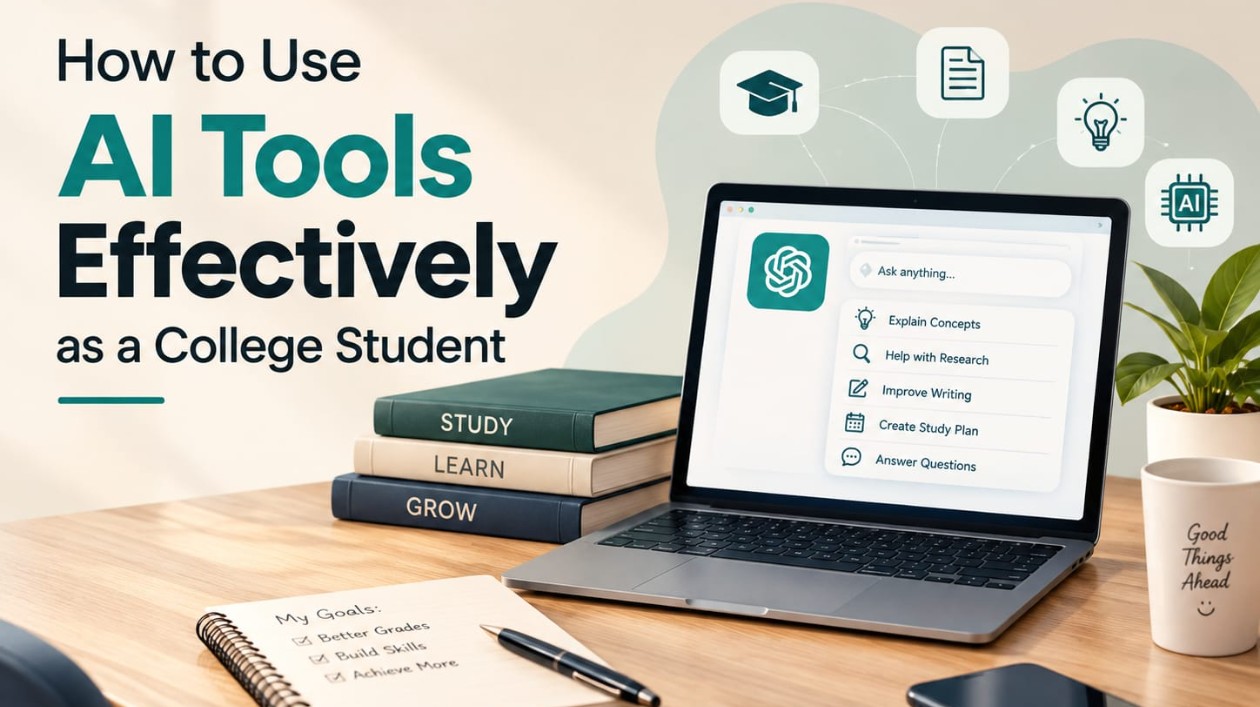
Artificial intelligence has quickly become a useful part of student life. From explaining difficult concepts and organizing study notes to helping with research and improving writing, AI tools can save time and make learning more efficient. However, using AI effectively is not about letting it do all the work. Students should use AI as a learning assistant while developing their own knowledge, critical thinking, and problem-solving skills.
1. Use AI to Understand Difficult Concepts
One of the simplest ways to use AI is to ask it to explain topics you find difficult. Instead of simply copying an answer, ask the AI to explain the concept in simple language, provide examples, or break it into smaller steps.
For example, if you are struggling with a complex programming concept, you can ask AI to explain it as if you are a beginner and then provide a simple example.
This can make difficult subjects easier to understand and help you study at your own pace.
2. Improve Your Research Process
AI tools can help students get started with research by brainstorming research questions, identifying possible topics, and organizing ideas.
You can use AI to turn a broad topic into a focused research question or create a basic outline for your paper. However, AI-generated information should not automatically be treated as reliable.
Always verify important facts using credible academic sources, research papers, books, and trusted databases.
3. Use AI for Writing and Editing
AI can be useful when you already have your own ideas but need help improving the writing.
Students can use AI to identify grammar mistakes, improve sentence structure, make paragraphs clearer, or suggest better ways to organize an assignment.
For example, you can write your own paragraph first and then ask an AI tool to improve its clarity while keeping the original meaning.
The goal should be to improve your writing—not replace your own thinking.
4. Create Personalized Study Plans
College students often have multiple subjects, assignments, tests, and deadlines to manage. AI can help organize these responsibilities into a practical study schedule.
You can provide your subjects, available study hours, upcoming exams, and deadlines and ask AI to create a study plan.
AI can also help divide a large assignment into smaller tasks, making it easier to stay organized and avoid last-minute studying.
5. Practice Before Exams
AI can also work as a study partner. Ask it to create practice questions, quizzes, flashcards, or short-answer questions based on a topic you are studying.
After attempting the questions yourself, you can use AI to explain the answers or identify areas where you need more practice.
This approach makes studying more active instead of simply reading notes repeatedly.
6. Learn How to Write Better Prompts
The quality of an AI response often depends on how clearly you explain what you need.
Instead of asking:
“Explain economics.”
Try a more specific prompt such as:
“Explain the concept of inflation in simple language, give two real-world examples, and list the main factors that cause inflation.”
Providing context, specifying the desired format, and clearly describing your goal can produce much more useful results.
7. Always Check AI-Generated Information
AI tools can sometimes provide incorrect, outdated, or misleading information. They may also produce references that do not exist or misunderstand the context of a question.
For academic work, important information should always be checked against reliable sources.
Before using an AI-generated fact, statistic, quotation, or reference in an assignment, verify it through credible sources such as academic journals, official websites, textbooks, or recognized research databases.
8. Protect Your Academic Integrity
AI should support learning rather than become a shortcut for completing assignments without understanding them.
Different colleges and universities may have different rules regarding AI-generated content. Before using AI for an assignment, check your institution's academic-integrity policies and your instructor's requirements.
If AI assistance is allowed, use it responsibly and follow any disclosure or citation requirements.
## Use AI as a Learning Assistant
AI can help college students learn faster, organize their workload, improve their writing, and explore new ideas. But the most valuable skills—critical thinking, creativity, communication, and independent problem-solving—still need to be developed by the student.
The best approach is to use AI to **learn, practice, organize, and improve**, rather than simply asking it to complete everything for you.
When used responsibly, AI can become a powerful study companion while still keeping the student at the center of the learning process.