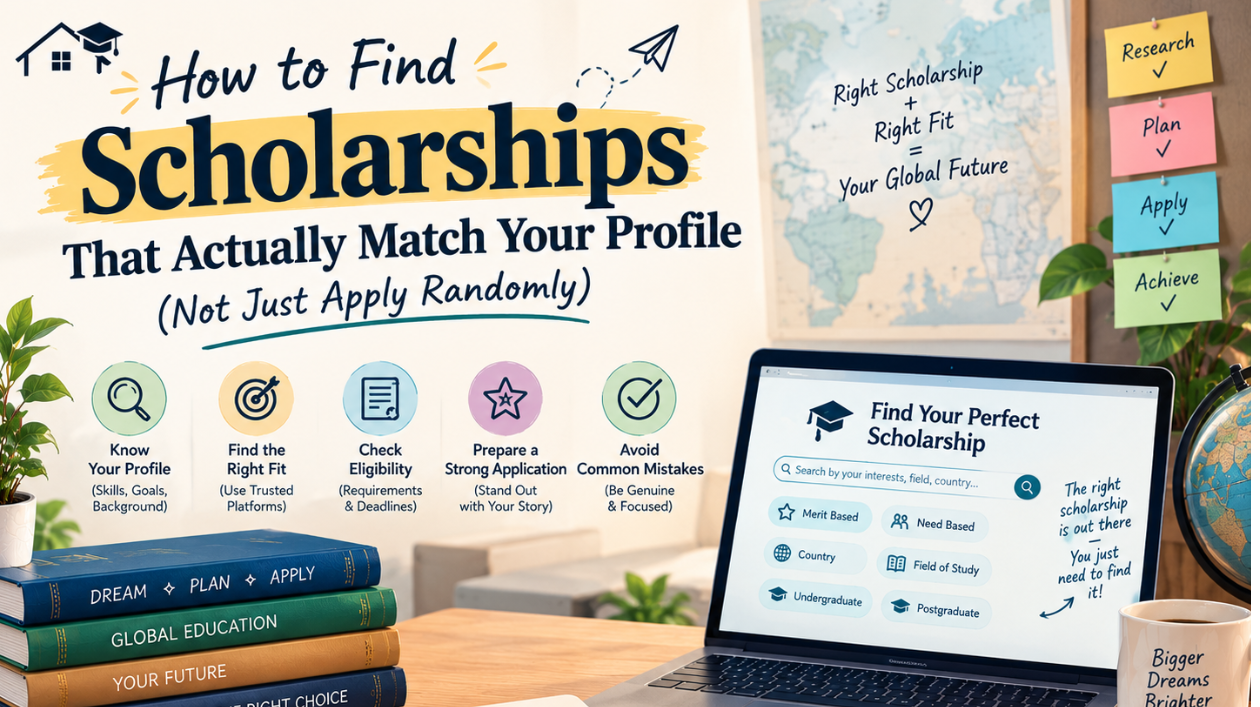
Many students approach scholarships the wrong way—applying to as many as possible, hoping something eventually works out. While persistence matters, applying randomly without checking whether you're actually a strong fit usually leads to wasted time, repeated rejection, and unnecessary frustration.
The students who consistently win scholarships aren't always the most qualified on paper—they're often the ones who apply strategically, to opportunities that genuinely match who they are. Here's how to do that properly.
1. Start With Self-Assessment, Not Scholarship Lists
Before searching for scholarships, take a step back and clearly define your own profile:
- Your academic strengths and field of study
- Your extracurricular activities, leadership roles, or volunteer work
- Your financial need (if relevant)
- Your nationality, region, or community background
- Your long-term career or academic goals
Most students skip this step and jump straight into browsing scholarship websites. But knowing your own profile first makes it much easier to recognize which scholarships are actually worth your time.
2. Understand That Scholarships Have a "Type"
Scholarships generally fall into a few categories, and understanding these helps you narrow your search significantly:
- **Merit-based** — for strong academic or extracurricular achievement
- **Need-based** — for students with demonstrated financial need
- **Field-specific** — for particular subjects like STEM, public policy, or the arts
- **Nationality or region-specific** — often government-funded, limited to certain countries
- **Identity or background-based** — for first-generation students, women in specific fields, underrepresented communities, etc.
- **Career-goal-based** — tied to a specific future plan, like public service or research
Instead of searching "scholarships for international students," search using terms that match your actual category, such as "need-based scholarships for engineering students from Pakistan." The more specific your search, the more relevant your results.
3. Read the Eligibility Criteria Like a Checklist
This is where many students go wrong—they get excited about a scholarship's funding amount or prestige without carefully checking if they qualify.
Before applying, go through the eligibility section and check:
- Required academic background or GPA
- Nationality or residency requirements
- Field of study restrictions
- Age limits (some scholarships have them)
- Required documents or language proficiency scores
If you don't meet the core requirements, applying anyway usually wastes time that could go toward a scholarship you actually qualify for.
4. Look Beyond the Big, Well-Known Scholarships
Scholarships like Chevening, Fulbright, or DAAD are highly competitive simply because everyone applies to them. While it's worth trying if you're a strong fit, don't ignore smaller, lesser-known scholarships offered by:
- Specific university departments
- Regional foundations or nonprofits
- Professional associations related to your field
- Alumni-funded awards at your target university
These often have far less competition and, in many cases, criteria that align more closely with a specific type of student—possibly you.
5. Match the Scholarship's Mission to Your Own Story
Every scholarship exists to support a particular kind of student or cause. Before applying, ask yourself honestly: does my background, goals, and story genuinely align with what this scholarship is trying to support?
For example, a scholarship focused on supporting first-generation university students expects your essay and profile to reflect that experience authentically. Applying to a scholarship whose mission doesn't align with your actual story rarely results in a strong, convincing application—no matter how well it's written.
6. Use Reliable Scholarship Databases
Rather than randomly searching and hoping for accurate results, use trusted platforms that let you filter scholarships by your specific profile:
- University financial aid or international student offices
- Government education portals (e.g., DAAD, Chevening, Fulbright official sites)
- Scholarship databases that allow filtering by field, nationality, and degree level
Filtering by your specific criteria saves significant time compared to scrolling through generic scholarship lists.
7. Keep a Personal Scholarship Tracker
Once you start identifying scholarships that genuinely match your profile, keep a simple tracker (a spreadsheet works fine) with:
- Scholarship name and link
- Eligibility summary
- Deadline
- Required documents
- Application status
This helps you stay organized and avoid missing deadlines for the scholarships that are actually worth your effort.
8. Quality Over Quantity
It's tempting to think that applying to fifty scholarships increases your chances more than applying to ten. In reality, five well-matched, thoughtfully completed applications usually perform better than twenty rushed, generic ones sent to scholarships you don't strongly qualify for.
Focus your energy on scholarships where you can write a genuine, specific essay—not a recycled one that doesn't quite fit.
### Final Thoughts
Winning a scholarship isn't just about being a good student—it's about applying to the right opportunities and presenting yourself as a clear, authentic match for what that scholarship is looking for. Instead of applying randomly and hoping something sticks, take the time to understand your own profile first, then search intentionally.
A focused, well-matched application will almost always outperform a scattered, random one—both in your chances of winning and in how much you learn about yourself along the way.