
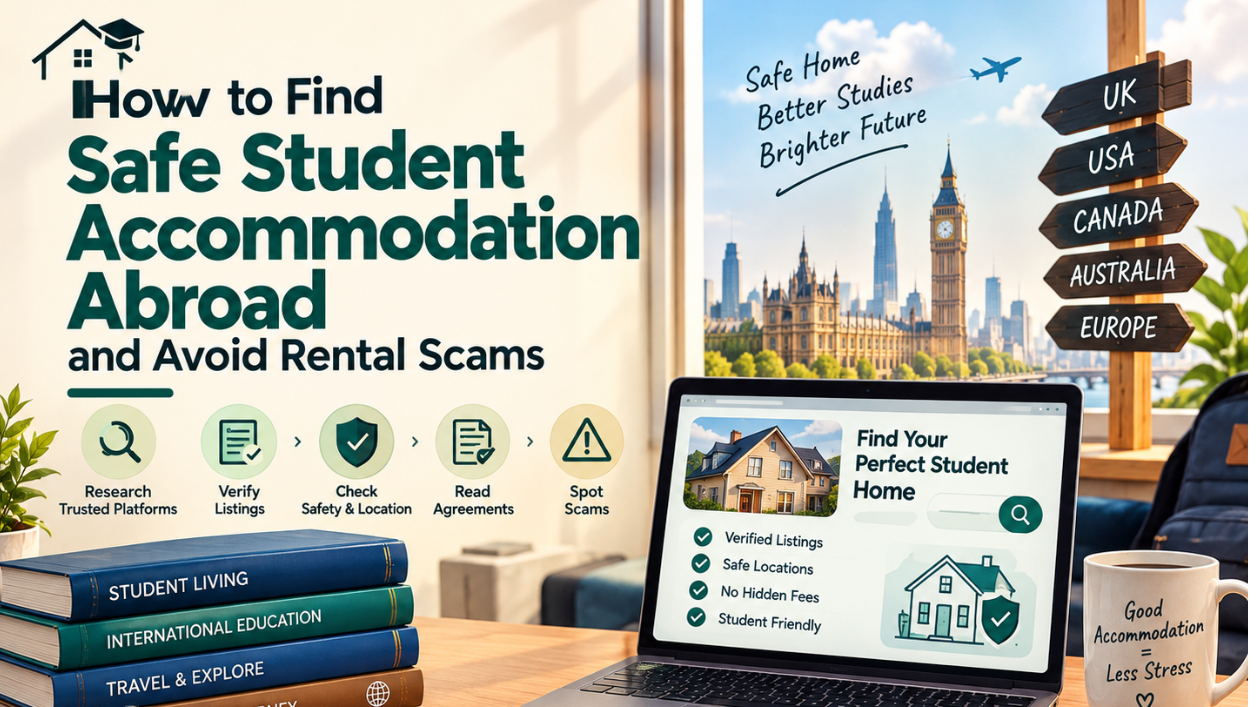
Finding a place to live is one of the biggest worries for international students. You are often searching from another country, under time pressure, in a rental market you do not know yet. Scammers understand this, and every year students lose deposits and rent to fake landlords, cloned adverts and fraudulent agents.
The good news is that most housing scams follow the same pattern, and a few simple habits can protect you. This guide explains where to look, how to verify a listing, what the rules say in several popular study destinations, and what to do if something goes wrong.
Why International Students Are Targeted
- You often book from a distance, so you cannot inspect the property yourself.
- You may not know what a normal price, contract or deposit looks like in that country.
- Housing shortages near universities create pressure to decide fast.
- You may be sending money across borders, which is hard to recover.
Scammers exploit exactly these gaps, usually with a low price, an urgent deadline and a story about why you cannot see the property first.
Your Main Housing Options
University halls of residence. Usually the safest choice for your first year, especially if you are arriving from abroad. Apply as soon as you receive your offer, because places can fill quickly.
Purpose-built student accommodation (PBSA). Private companies that run student buildings. Choose well-known providers and check that the building is real and the company is registered.
Private flats and shared houses. Often cheaper and more flexible, but they carry the highest scam risk. Use verified platforms and never skip the checks below.
Homestay. Living with a local family can be a safe and friendly start, particularly for younger students, but arrange it through your university or a recognised organisation.
Temporary housing first. Many students book a hostel, a short-term rental or university accommodation for the first two to four weeks, then search for a longer-term place after arriving, when they can inspect properties in person. This removes much of the pressure to commit from abroad.
Step-by-Step: How to Find Safe Accommodation
1. Start with your university
Contact the accommodation office or international student office as soon as you are admitted. They usually keep verified listings, can advise on trusted providers, and will often check a suspicious offer for you before you pay. Ask current students in your programme, too, since many good rooms are found by word of mouth.
2. Use trusted platforms and registered agents
Stick to well-known student housing providers and established rental websites, and be aware that scams can still appear on any platform. In the UK, for example, students' unions recommend using your university's accommodation office or agents registered with bodies such as ARLA, RICS, SafeAgent or The Property Ombudsman. In Germany, students commonly use the Studierendenwerk (student services), WG-Gesucht and ImmobilienScout24. Whatever the country, check what the local equivalent is.
3. Learn what a normal price looks like
Compare several listings in the same area. A central, furnished flat far below the local average is one of the most common bait tactics.
4. See the property before you pay
Never pay a deposit, holding fee or rent before you have seen the place, either in person or through someone you trust, such as a relative, a friend or a university adviser. If that is impossible, ask for a live video tour with someone who can show the exact rooms, the building entrance and the street. Ask them to show specific things you choose, in real time. Be aware that some scammers now use AI-generated descriptions and even fake video identities, so a video call helps but is not proof on its own.
5. Verify the landlord or agent
- Do a reverse image search on the photos. If the same pictures appear on several unrelated listings, it is probably a scam.
- Check whether the agent is registered with a professional body, and call the agency using the phone number on its official website, not the number in the advert.
- Look for cloned websites that copy a real company's name and design.
- Where possible, check who legally owns the property. In some countries you can look up the registered owner in the land registry for a small fee, and the name should match the person you are dealing with.
- Be cautious if someone asks for a copy of your passport, ID or bank statements before you have seen anything. Identity theft is also a purpose of some fake listings.
6. Get a written contract before you pay
Never accept "we will sort out the contract when you arrive". Read the agreement carefully, and check the rent, the deposit amount, the length of the contract, what is included (heating, water, internet) and how the deposit is returned. Ask your university's advice service to look at it if you are unsure.
7. Pay safely
- Pay only after you have seen the property and signed a proper contract.
- Use traceable methods that give you a receipt, and pay into a bank account that matches the name of the landlord or agency, ideally in the country where the property is.
- Avoid cash, gift cards, cryptocurrency and money transfer services when paying a stranger.
- Keep every receipt, message and screenshot.
8. Check that your deposit is protected
In many countries the law limits how much a landlord can take and requires the deposit to be kept in a protected scheme. Ask where your deposit will be held, and verify this yourself.
9. Inspect and document on move-in day
Take dated photos and videos of every room, fill in the inventory or condition report, and keep a copy. This protects your deposit when you leave.
Country Snapshots: What the Rules Say
These rules change, and they differ between regions, so always confirm with official sources or your university.
England (UK). Since 1 May 2026, the Renters' Rights Act has limited rent in advance to one month, banned bidding above the advertised rent, and left the deposit cap at five weeks' rent (six weeks if annual rent is £50,000 or more). Landlords must protect your deposit in a government-approved scheme within 30 days, and a holding deposit is capped at one week's rent. Letting fees are generally banned. University halls and purpose-built student accommodation are not covered by the Act in the same way, and Scotland, Wales and Northern Ireland have their own rules.
Germany. The deposit (Kaution) is capped at three months' cold rent (Kaltmiete, the rent before utilities), and can usually be paid in three monthly instalments. Charging a fee just to view a flat is not allowed. Police guidance warns students never to pay money before viewing an apartment, not to accept cheques, and not to have keys sent by post or through agents. After moving in, you generally need to register your address (Anmeldung) within about two weeks, which requires a confirmation from your landlord, so make sure your room allows registration.
Australia. A rental bond, commonly up to four weeks' rent in states such as New South Wales and Queensland, must be lodged with the state's bond authority, not simply kept by the landlord. You should receive a receipt or bond number. A typical scam involves a "landlord" who says they are overseas and promises to post the keys after you pay a bond.
Canada. Rules vary by province. In Ontario, for example, a landlord can generally ask only for last month's rent and a refundable key deposit, and damage or security deposits are not allowed. Landlords must also use the Ontario Standard Lease. Other provinces have different limits, so check your provincial tenancy authority.
United States. Tenant laws differ widely by state and city. Ask for a written lease and a receipt for every payment, and confirm the owner or property manager before sending any money.
Common Scams and Red Flags
- Fake listings using stolen photos and a very low price
- A landlord who is "abroad" and offers to send the keys by courier or post
- Requests for a deposit, reservation fee, holding fee or viewing fee before you see the property
- Pressure such as "several people are interested, pay today"
- Refusal to do a live video tour, or communication only through messaging apps
- Cloned agency websites, or an email address that does not match the company
- A contract that is missing, vague or "not needed"
- A property that is different from the one you were shown, or a landlord who cannot prove ownership
- Payment requests to a personal account in another country
- A deposit that is not placed in a protected scheme where the law requires it
A Quick Checklist Before You Pay
1. Have I seen the property in person or through a trusted person or live video?
2. Have I checked the photos with a reverse image search?
3. Does the price match the local market?
4. Have I verified the landlord's or agent's identity and registration?
5. Do I have a written contract that I have read?
6. Is the deposit within the legal limit and protected?
7. Am I paying by a traceable method to an account that matches the landlord or agency?
8. Have I asked my university's housing office or advice service to check it?
9. Do I have a backup place to stay if this falls through?
What to Do If You Have Been Scammed
1. Stop all payments and contact the scammer no further.
2. Call your bank immediately and ask about a recall or chargeback. If you gave out bank or personal details, change your passwords and ask the bank to secure your account.
3. Save all evidence: the advert, screenshots, messages, receipts and payment confirmations.
4. Report the listing to the website or platform where you found it.
5. Report the fraud to the police and to your country's fraud reporting service, for example Action Fraud or Report Fraud in the UK, Scamwatch in Australia, or the Canadian Anti-Fraud Centre in Canada.
6. Tell your university's housing or international student office. They can support you and warn other students.
7. Be careful of people who contact you offering to "recover" your money for a fee. That can be a second scam.
Recovering money from scammers is often very difficult, especially after wire transfers or gift cards, so prevention matters most.
Frequently Asked Questions
Should I book accommodation before I arrive?
University halls or a well-known student housing provider are generally safe to book in advance. For private rentals, many students book temporary accommodation and search after arriving, so they can inspect properties in person.
Is a video tour enough?
It is a useful step, but not proof on its own. Combine it with checking the landlord, confirming ownership where possible, reading a written contract and paying safely.
Is it normal to pay a holding deposit?
Sometimes, but it should be done through a formal, secure process with a written receipt, and the amount may be limited by law. Never pay one to someone you have not verified, and never before you have seen the property.
Can I trust housing groups on social media?
They can be a good source of leads but are also where many scams appear. Treat every offer as unverified until you have checked it.
What if I cannot afford university accommodation?
Ask your university about cheaper halls, shared housing lists, hardship funds and advice on sharing costs with other students. Do not accept a suspiciously cheap deal out of desperation.
Final Thoughts
A safe home makes everything else easier: studying, making friends and settling into a new country. Start early, use your university's support, verify before you pay, and be willing to walk away from any offer that pressures you. Real landlords and agents will understand your caution, and the ones who do not are usually the ones to avoid.
Sources and Further Reading
- Tenancy Deposit Scheme, Renters' Rights Act updates: tenancydepositscheme.com/renters-rights-act-updates
- Unite Students, How to avoid uni accommodation scams: unitestudents.com
- University of Melbourne Student Housing, Avoiding scams: housing.unimelb.edu.au/pages/avoiding-scams
- Queensland Residential Tenancies Authority, Rental scams: rta.qld.gov.au
- RCMP (Canada), Rental scams: rcmp.ca
- University of Toronto Community Safety Office, Landlord or rental scams: communitysafety.utoronto.ca
- Karlsruhe Institute of Technology (KIT) International Students Office, Scam offers when looking for an apartment: intl.kit.edu
---