
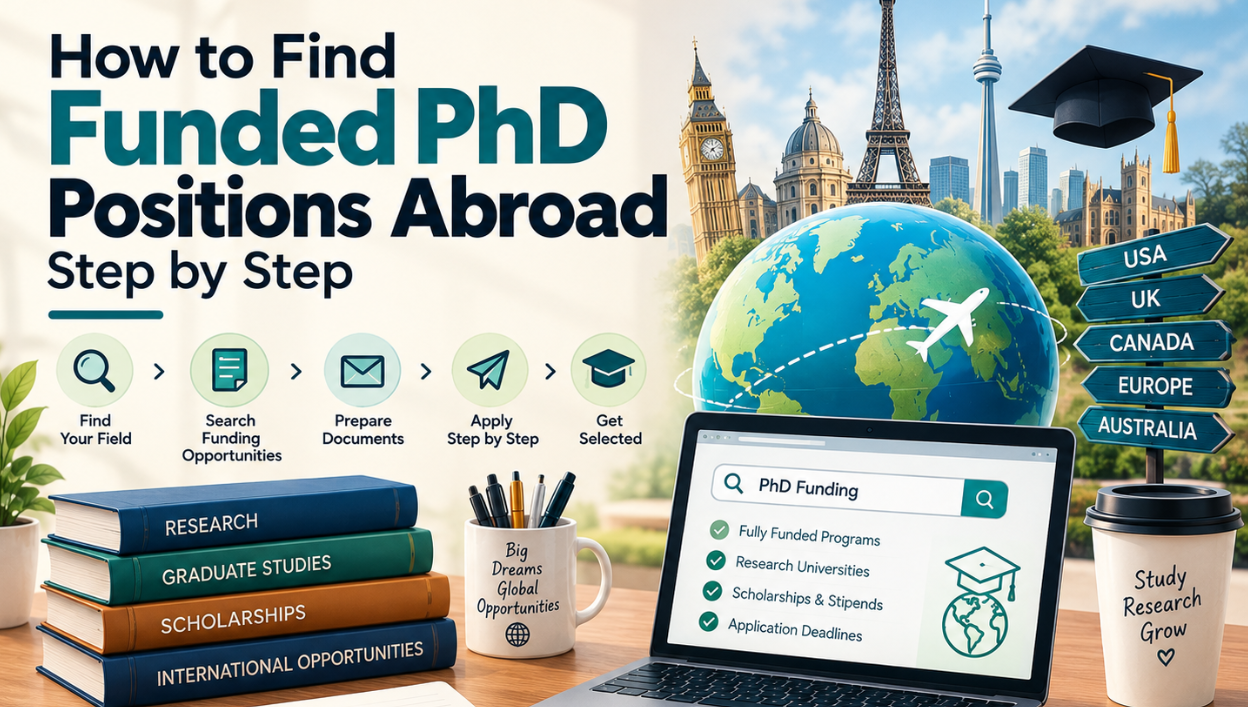
Many students believe a PhD abroad is only for the wealthy, but that is often not true. In many countries, a PhD is treated more like a research job than a paid course. Your tuition is covered, and you receive a salary or stipend to live on. The real challenge is not the cost; it is knowing where to look, whom to contact and how to present yourself.
This step-by-step guide explains how funded PhD positions work, where to find them, how to contact supervisors, and what to check before you accept an offer.
What Does "Funded PhD" Mean?
A funded PhD usually covers your tuition fees and gives you money for living costs. It comes in three main forms:
1. Employment contract. In several countries, doctoral candidates are hired as employees, so the salary is the funding, and you are applying for a job. This is common in the Netherlands, Sweden and Norway, and Germany uses both employment and scholarships.
2. Assistantship or studentship. A university or department funds you through teaching or research work, or through a fellowship. This is the standard model in the USA and a common one in the UK.
3. External scholarship. A government or foundation pays for you, such as DAAD, Fulbright, Commonwealth, the Chinese Government Scholarship or HEC.
Knowing which model you are applying for changes how, when and where you apply.
Step 1: Check Your Eligibility and Choose Your Research Area
Start by asking honestly where you stand.
- Degree level. Many US PhD programmes, especially in STEM, accept students directly after a four-year bachelor's degree. European positions, including EU-funded doctoral networks, usually require a master's degree or equivalent. Pakistani students with a 16-year degree should check each programme's requirements carefully.
- Research area. Choose a narrow area you can explain, such as "machine learning for medical imaging" rather than just "computer science."
- Grades and English. Check the minimum CGPA and any English test requirement for your targets.
Step 2: Build a Research Profile
Supervisors want evidence that you can do research. Strengthen your profile with:
- A strong master's thesis or final year project
- Publications, conference papers or posters, even small ones
- Research assistant experience or internships in a lab
- Technical skills relevant to your field, such as programming, statistics or lab methods
- Strong recommendation letters from professors who know your work
If you are still a student, start early. Research experience often matters more than a perfect GPA.
Step 3: Choose Destinations by Funding Model
United States. Most PhDs are fully funded with a tuition waiver, a yearly stipend and health insurance, typically through teaching or research assistantships or fellowships. Most Fall deadlines fall between 1 December and 15 January, so you should start preparing 12 to 18 months before your start date. Many top programmes have made the GRE optional or dropped it, but some fields still expect it, so check each department's page. Note that a funding guarantee is usually conditional on good academic standing and performance of your duties, and stipends are taxable. If a US PhD offer does not include full funding, treat that as a red flag.
United Kingdom. UKRI studentships give a tax-free stipend, £21,805 per year for 2026/27, plus tuition fees at the Home rate. International students can apply, but they are generally limited to about 30 percent of the funded places, and the UKRI fee contribution may not cover the full international fee, so always confirm in writing who pays the difference. UKRI awards also do not cover visa costs, the Immigration Health Surcharge or flights. You apply through the university or doctoral training partnership, not through UKRI directly, and most deadlines fall between December and February. University scholarships, such as Vice-Chancellor or President's scholarships, and Commonwealth awards are other routes.
Germany. There is no central application system. Most individual doctoral candidates are hired as research associates (Wissenschaftliche Mitarbeiter) at a professor's chair, usually on a part-time contract, and you find positions by contacting professors or responding to job advertisements. Structured doctoral programmes and graduate schools are another route, and the DAAD offers scholarships for doctoral study.
Netherlands, Sweden, Norway and other Nordic countries. PhD candidates are typically employed staff with a salary, and positions are advertised as job openings.
European Union (MSCA Doctoral Networks). These are EU-funded doctoral programmes that offer employment contracts, and vacancies must be advertised internationally, including on EURAXESS. Candidates of any nationality can apply, but they must meet the mobility rule: in general, you must not have lived or worked or studied in the country of the hiring institution for more than 12 months in the three years before recruitment. As an example of timing, two 2026 networks had application deadlines in October 2026 (1 October and 15 October), and networks funded from the 2026 call are expected to start advertising positions in spring 2027.
Step 4: Know Where to Find Positions
Use a mix of portals and direct searching:
- EURAXESS: The European Commission's research jobs portal. Filter by country, field and the "Doctoral Candidate" level.
- FindAPhD: Broad search, with a filter for international eligibility.
- Academic Positions: A European-focused academic job board with email alerts.
- DAAD PhDGermany database: Lists open PhD positions in Germany that target international applicants, and the DAAD also lists roughly 230 international doctoral programmes.
- Academics.de and research organisation websites: Max Planck, Helmholtz, Leibniz and Fraunhofer maintain their own job portals.
- jobs.ac.uk (UK), AcademicTransfer (Netherlands) and Nature Careers (elite STEM labs).
- University department pages, lab websites and graduate school pages.
- Google Scholar: Search papers in your topic and see where the authors work.
- LinkedIn, X and academic conferences: Professors sometimes announce openings before they appear on portals.
Set up weekly alerts for your field and countries, and check regularly, because positions can be filled quickly.
Step 5: Find the Right Supervisor
Your supervisor matters more than the university's ranking. To find a good match:
- Read recent papers from the group and understand their methods.
- Check the lab website for current projects, funding announcements and open positions.
- Look at how many students they supervise and where their previous students went.
- Choose professors whose research genuinely overlaps with yours, rather than emailing everyone.
Step 6: Write a Professional Email
A strong email is short, specific and respectful. Avoid mass emails, generic praise and long life stories.
Include:
- A clear subject line, such as "Prospective PhD applicant: [your research area]"
- Who you are, your degree and university
- A specific reason you are contacting this professor, mentioning one or two of their papers
- Your relevant research experience in two or three sentences
- A clear question about whether they have funded PhD openings
- Your CV attached, and a polite closing
Template:
Subject: Prospective PhD applicant: [Research area]
Dear Professor [Surname],
I am [Name], a [degree] student/graduate of [university], Pakistan, with research experience in [area]. I read your recent papers on [topic] and was particularly interested in [specific point].
During my [thesis/project], I worked on [brief description], which resulted in [result, publication or skill]. I am now looking for a funded PhD position starting in [month, year] and believe my background fits your group's work on [topic].
Do you currently have any funded PhD openings, or do you expect to recruit for [year]? I have attached my CV and would be happy to share my transcripts and research proposal if useful.
Thank you for your time and consideration.
Kind regards,
[Name]
[LinkedIn / Google Scholar link]
If you do not hear back, one polite follow-up after about two weeks is reasonable. After that, move on.
Step 7: Prepare Your Application Documents
Most applications need:
- Academic CV focused on research
- Statement of purpose or motivation letter tailored to each position
- Research proposal (common in the UK and some European programmes)
- Transcripts and degree certificates (and equivalence documents where required)
- Two or three recommendation letters
- English test scores, such as IELTS or TOEFL, if required
- Publications or thesis abstract
Customise your statement for each application. Explain why this group, why this topic and why you.
Step 8: Apply for External Scholarships in Parallel
Do not rely on a single route. Alongside direct applications, look at scholarships that fund your PhD:
- HEC Overseas Scholarships: HEC's 2026 call (Phase-III, Batch-IV) covered MS/MPhil and PhD study at Top 200 QS/THE-ranked universities in selected fields. It required at least 18 years of education for PhD applicants and an HEC Aptitude Test (HAT), with candidates holding unconditional admission at eligible top-ranked universities exempted from the test and interview. Its deadline was 28 August 2026, so watch the HEC website for the next call. HEC also states that if a university's tuition exceeds the amount allocated, the candidate must secure a fee waiver.
- Fulbright: Applications in many countries close 12 to 14 months before the programme starts, earlier than most university deadlines.
- DAAD, Commonwealth, the Chinese Government Scholarship and others: Check each scholarship's website for deadlines and eligibility.
An offer from a professor can also strengthen your scholarship application, so contacting supervisors early helps on both fronts.
Step 9: Read the Offer Carefully Before You Accept
Before accepting any position, confirm:
- Does it cover full tuition, including international fees?
- What is the monthly stipend or salary, and for how many years?
- Is the funding guaranteed, and under what conditions?
- Are health insurance, visa costs and flights covered?
- What are the teaching or work duties?
- Are there taxes or contract conditions you should know about?
- Can you afford living costs in that city?
Ask for the details in writing. A vague "you will get funding" is not enough.
A Simple Timeline
12 to 18 months before start: Choose your research area, build your profile and start reading papers.
9 to 12 months before: Shortlist supervisors, contact them and prepare English tests and documents.
6 to 9 months before: Submit applications (US and UK deadlines are often December to February) and external scholarship applications.
3 to 6 months before: Interviews, offers and comparing funding packages.
1 to 3 months before: Visa, housing and travel preparation.
Red Flags and Scams
- Anyone who asks you to pay to "secure" a funded position
- "Guaranteed admission" or "guaranteed scholarship" promises
- Positions that do not name a real professor, department or contract
- Unofficial websites that ask for your passport or bank details early
- Offers that require you to pay a large fee upfront to an agent
Real universities do not charge you a fee to give you a funded PhD offer, though some charge a normal application fee.
Common Mistakes to Avoid
- Sending the same email to dozens of professors
- Applying to only one country or one funding route
- Starting too late, especially for US, UK and scholarship deadlines
- Ignoring tuition-fee gaps in international offers
- Choosing a university by ranking without checking the supervisor
- Submitting a generic statement of purpose
- Overlooking the MSCA mobility rule and other eligibility conditions
Frequently Asked Questions
Do I need a master's degree to get a funded PhD abroad?
It depends on the country. Many US programmes accept students directly after a four-year bachelor's degree, while European positions usually require a master's or equivalent.
Are funded PhDs really free?
Tuition is usually covered, but you still need to plan for application fees, visa costs, flights and settling-in costs. Check what each offer includes.
Is the GRE required?
It varies by university and department. Many have made it optional or dropped it, while some fields still expect it. Check each programme's official page.
Do I have to email professors first?
For many positions in Europe and for direct-supervisor models, yes, contacting a professor helps a lot. For advertised positions and structured programmes, you can usually apply directly through the portal.
How many places should I apply to?
Apply to a realistic mix, for example 8 to 12 positions, across different countries and funding routes, with tailored applications rather than copied ones.
Final Thoughts
Finding a funded PhD position takes planning, research and patience, but it is achievable. Build your research profile, choose destinations that match your funding needs, contact the right supervisors with clear and honest emails, and apply early across several routes. Rejections are normal, and each application teaches you how to improve the next one.
---