
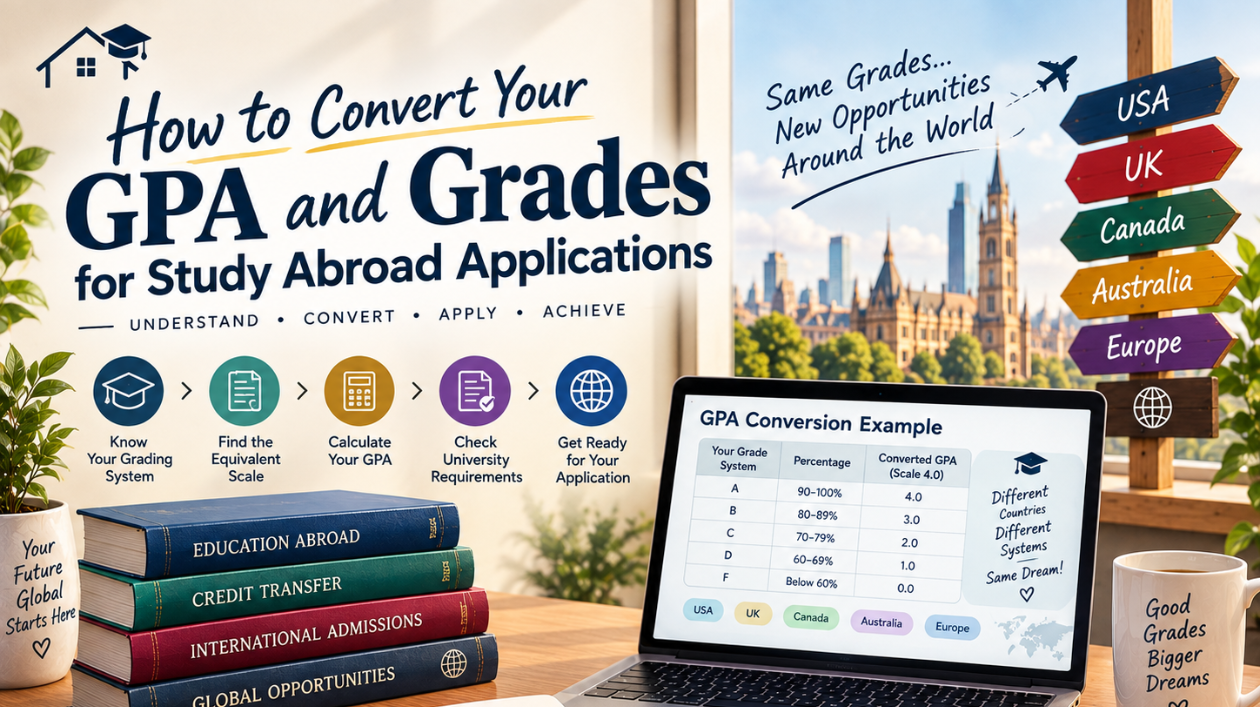
If you're planning to study abroad, one of the most confusing parts of the application process is figuring out how your grades translate into the grading system of another country. Every country—and sometimes every university—has its own way of measuring academic performance, and getting this conversion wrong can hurt your application or delay your admission process.
This guide breaks down exactly how GPA conversion works and how you can do it correctly.
1. Understand Why GPA Conversion Matters
Universities abroad need a standardized way to compare applicants from different education systems. A "70%" in one country might be considered excellent, while in another it could be average. Without proper conversion, admission committees may misjudge your academic standing.
That's why most universities either:
- Ask you to submit your original transcript along with a converted GPA, or
- Use their own internal conversion tools to evaluate international applicants.
Knowing this helps you present your academic record accurately and confidently.
2. Know Your Own Grading System First
Before converting anything, get clarity on how your current system works. For example:
- Percentage-based systems (common in Pakistan, India, and several other countries)
- CGPA systems (often out of 4.0)
- Letter grade systems (A, B, C, etc.)
Check your official transcript or academic policy document to confirm the exact scale your university follows, since some universities use a 4.0 scale while others use a 4.3 or 5.0 scale.
3. Learn the Target Country's Grading Scale
Each destination country has its own standard:
- **USA & Canada:** Mostly 4.0 GPA scale
- **UK:** Uses classifications like First Class, Upper Second (2:1), Lower Second (2:2)
- **Germany:** Uses a reverse scale where 1.0 is the best and 4.0 is a pass
- **Australia:** Often uses GPA out of 7.0 or percentage-based systems depending on the university
Research your target university's official website, as many publish their own conversion charts for international students.
4. Use Reliable GPA Conversion Tools
Instead of manually calculating everything, use trusted conversion resources such as:
- WES (World Education Services) — widely accepted for USA/Canada applications
- Scholaro GPA Calculator
- University-specific conversion charts (usually found on the admissions or international students page)
These tools convert percentages or local CGPA into the equivalent GPA scale required by your target university.
5. Double-Check University-Specific Requirements
Some universities don't rely on generic conversion tools—they have their own formula or minimum GPA requirement in their own scale. Always check:
- The official admissions page for GPA requirements
- Whether they require WES/ECE evaluation
- Whether a minimum percentage equivalent is mentioned instead of GPA
If you're unsure, email the admissions office directly. It's a completely normal question, and they deal with it regularly.
6. Get an Official Credential Evaluation (If Required)
Many countries, especially the USA and Canada, require a formal credential evaluation from an approved agency. This is different from a simple online GPA calculator—it's an official document that verifies and converts your academic record for admission and, later, visa purposes.
Popular evaluation services include:
- WES (World Education Services)
- ECE (Educational Credential Evaluators)
- IQAS (for Canada)
Start this process early, as evaluations can take a few weeks to complete.
7. Keep Supporting Documents Ready
Along with your converted GPA, most universities will ask for:
- Original transcripts (in English or with certified translation)
- Grading scale explanation from your institution (some universities provide this on request)
- Degree certificates
Having these ready in advance saves time and prevents last-minute application stress.
### Final Thoughts
GPA conversion might feel intimidating at first, but it's a straightforward process once you understand your own grading system, your target country's requirements, and the right tools to use. Take your time, verify information directly from official university sources, and don't hesitate to reach out to admissions offices if anything is unclear.
A properly converted GPA doesn't just meet a requirement—it presents your academic achievements accurately to the people deciding your future.
---