
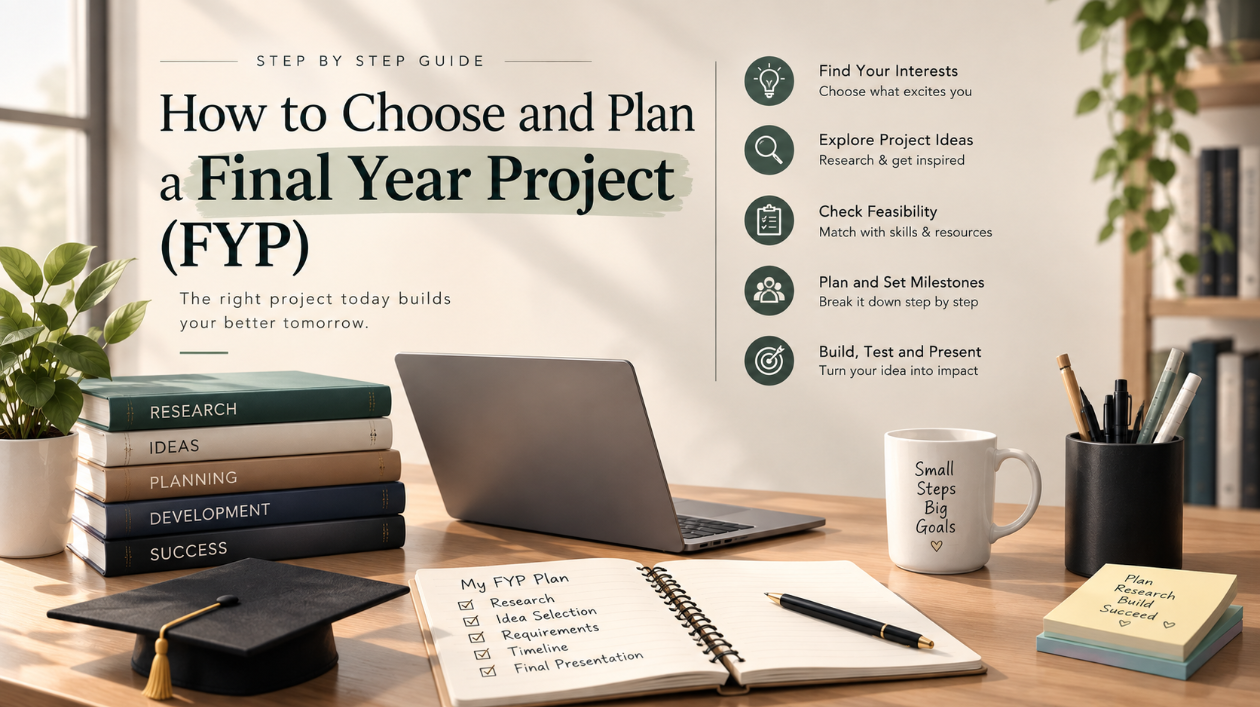
For most students, the final year project is the most important piece of work in their degree. It is often the first time you solve a real problem from start to finish, and it becomes a major talking point in interviews, on your CV, and on your LinkedIn profile. Yet many students lose marks and momentum simply because they chose the wrong topic or started without a plan. The good news is that a strong FYP is less about genius ideas and more about smart choices, realistic planning, and consistent effort.
1. Understand What Evaluators Look For
Before choosing a topic, understand how your project will be judged. Read your department's FYP guidelines and, if possible, review past projects that scored well. Most evaluation committees look for a clearly defined problem, a sound methodology, technical or analytical depth, a working result or demo, and well-organized documentation.
Knowing this early helps you avoid a common mistake: building something impressive-looking that doesn't meet the department's requirements.
2. Choose a Topic That Solves a Real Problem
The best FYP topics sit at the intersection of your interests, your skills, and a genuine need. Start by observing problems around you, such as inefficiencies at your university, challenges faced by local businesses, or gaps in existing apps and services.
Ask yourself:
- Does this problem actually exist, and who would use the solution?
- Am I interested enough to work on it for eight to twelve months?
- Will this project help me in the career I want?
A focused topic works better than a broad one. Instead of "AI in Healthcare," consider something specific such as "A Mobile App for Early Detection of Skin Conditions Using Image Classification."
3. Check Feasibility Before You Commit
An exciting idea can still fail if it is not achievable. Before finalizing your topic, honestly assess:
- **Time:** Can it be completed within your academic calendar?
- **Skills:** Do you and your team have the required knowledge, or can you learn it in time?
- **Resources:** Do you have access to the data, hardware, software, or tools you need?
- **Cost:** Are there any expenses, and can your team manage them?
If any answer is uncertain, narrow the scope. It is far better to complete a smaller project well than to leave a large one unfinished.
4. Choose Your Supervisor and Team Wisely
Your supervisor can shape the quality of your project, so choose carefully. Look for a faculty member whose expertise matches your topic and who is approachable and responsive. Meet them early with a short summary of your idea and be open to their feedback.
If you are working in a group, pick teammates based on reliability and complementary skills, not just friendship. Agree on roles, communication methods, and expectations from the very beginning to avoid conflicts later.
5. Write a Clear and Strong Proposal
Your proposal is the foundation of the entire project. A good proposal typically includes:
- **Problem statement:** What problem are you solving, and why does it matter?
- **Objectives:** What exactly will your project achieve?
- **Scope:** What is included, and what is not?
- **Literature or market review:** What already exists, and how is your project different or better?
- **Methodology:** The tools, technologies, and steps you will use
- **Timeline:** A realistic plan with milestones
Keep the language simple and specific. Proposals that clearly define scope are far more likely to be approved and to succeed.
6. Plan Your Timeline and Manage the Project
Break the project into phases and assign deadlines to each. A simple structure could look like this:
- **First quarter:** Research, requirements, and design
- **Second quarter:** Development or data collection
- **Third quarter:** Testing, improvement, and evaluation
- **Final quarter:** Documentation, presentation practice, and final polish
Hold weekly team meetings, track tasks using free tools such as Trello or Notion, and use version control such as GitHub if your project involves code. Leave buffer time before every major deadline, because delays and technical problems are almost guaranteed.
7. Document as You Go and Prepare for the Defense
Many students leave documentation until the last month and regret it. Instead, write as you work: record decisions, save screenshots, note test results, and keep references organized. This makes your final report much easier and more accurate.
For the defense or viva, practice explaining your project simply. Be ready to answer why you chose this problem, why you used a particular approach, what limitations exist, and what you would improve. Prepare a smooth demo with a backup plan in case something fails during the presentation.
If you use AI tools for brainstorming, editing, or debugging, do so responsibly. Understand every part of your project, because evaluators will ask questions that only the real builders can answer, and always follow your department's academic integrity policy.
## Turn Your FYP into a Career Asset
A well-executed FYP is more than a graduation requirement. Publish your code on GitHub, write a short case study for your portfolio, add the project to your LinkedIn profile, and consider submitting it to a student competition or conference. These steps turn a single project into evidence of your skills that employers and admissions committees can actually see.
Choose a problem you care about, plan realistically, work consistently, and document honestly. A project built this way will not only earn you good marks but also give you something meaningful to talk about long after graduation.