
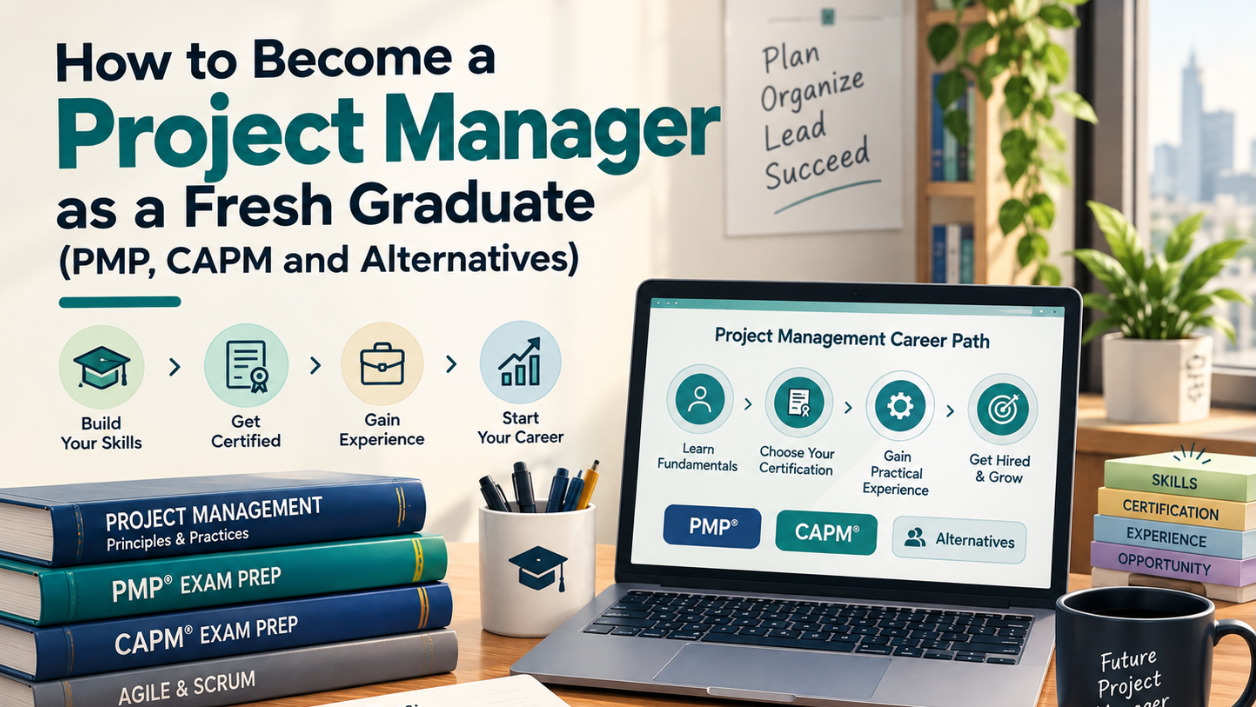
Project management is one of the most popular career goals for fresh graduates, and for good reason. Every industry, from software and construction to healthcare, marketing and NGOs, needs people who can plan work, manage teams and deliver results on time. But there is a common confusion: many students search for "PMP" first, without knowing that it is designed for people who already have years of project experience.
This guide explains what a project manager does, which entry-level roles to target, how PMP, CAPM and the Google Project Management Certificate differ, and a practical roadmap you can start right now.
What Does a Project Manager Do?
A project manager is responsible for delivering a project within its scope, timeline and budget. Typical duties include:
- Defining goals and the work that needs to be done
- Creating schedules and assigning tasks
- Managing budgets and resources
- Identifying and handling risks
- Communicating with team members, clients and other stakeholders
- Tracking progress and solving problems as they appear
Can a Fresh Graduate Become a Project Manager?
Most fresh graduates do not start with the title "Project Manager." A more realistic path is to begin in an entry-level project role and grow into management. Roles to search for include:
- Project coordinator or project assistant
- Project analyst or PMO (Project Management Office) assistant
- Associate or junior project manager
- Agile or Scrum coordinator
- Business analyst or operations coordinator
These roles let you learn how projects actually run, build evidence of your skills and gain the experience that later certifications and promotions require.
Skills You Need
Core project management skills:
- Planning and scheduling
- Scope, budget and risk management
- Stakeholder communication
- Agile and Scrum basics, as well as traditional (waterfall) planning
Soft skills:
- Communication and negotiation
- Leadership and teamwork
- Problem-solving and decision-making
- Time management and attention to detail
Tools to know:
- Excel or Google Sheets for tracking
- Trello, Asana, Notion or Jira for task management
- Microsoft Project or similar scheduling tools
- Basic AI tools for drafting reports, meeting notes and project plans, always checked by you before use
Step-by-Step Roadmap
Step 1: Learn the fundamentals
Start with the basics: the project life cycle, scope, schedule, budget, risk and stakeholder management. Understand the difference between predictive (waterfall) and agile approaches, since employers use both.
Step 2: Get hands-on experience now
You do not need a job title to practise project management. Look for opportunities to lead:
- Your final year project
- A society event, competition or fundraising drive
- A volunteering or NGO project
- A freelance or family business project
- An internship where you support a project team
Treat each one like a mini project. Write down the goal, team size, timeline, budget, risks you managed and the result. This becomes your evidence.
Step 3: Learn the tools
Set up a free Trello or Notion board for one of your projects. Practise building a schedule, assigning tasks and tracking progress.
Step 4: Choose a certification that fits your stage
See the comparison below. For fresh graduates, the Google Project Management Certificate and CAPM are the most practical options.
Step 5: Build your CV and portfolio
Show your projects, results and skills. Use numbers where you can, such as "Managed a team of 8 volunteers to organise a seminar for 300 students on a PKR 100,000 budget." Only include figures that are true.
Step 6: Apply for entry-level roles and network
Apply for coordinator, assistant and junior roles, and connect with project professionals on LinkedIn. Local PMI chapters in Karachi, Lahore and Islamabad run events, trainings and volunteer opportunities, which are good places to meet professionals.
PMP vs CAPM vs Google Certificate: Which One Should You Choose?
CAPM (Certified Associate in Project Management)
CAPM is PMI's entry-level credential. To qualify, you need a secondary degree and at least 23 hours of project management education completed before the exam. No project experience is required. The exam has 150 questions and a 180-minute time limit, and you can take it at a Pearson VUE test centre or securely online. As of May 2026, reported exam fees are USD 225 for PMI members and USD 300 for non-members, so confirm the current fee on the PMI website. The certification is valid for five years and can be renewed by retaking the exam or earning 15 PDUs.
Best for: Fresh graduates who want a globally recognised PMI credential.
PMP (Project Management Professional)
PMP is PMI's senior-level credential. If you have a four-year degree, you need 36 months of experience leading projects within the past eight years, or 60 months if you have a secondary diploma or associate degree, plus 35 hours of project management education or a CAPM. PMI has also said a revised PMP exam launched on 9 July 2026 with rebalanced domains and new topics such as AI, sustainability and value delivery, while eligibility requirements stayed the same. The experience must involve leading and directing projects, not just supporting them. Exam fees are reported at USD 405 for PMI members and USD 555 for non-members.
Best for: Professionals with about three years of real project leadership experience. It is not usually a starting point for fresh graduates, but a good long-term goal.
Google Project Management Certificate
This is a beginner-friendly online certificate on Coursera that requires no experience. Coursera says it can be completed in under six months at less than 10 hours per week, and most learners can finish for less than USD 300. In the US and Canada the subscription costs USD 49 per month after a 7-day free trial, and prices in other countries may be lower, so check the local price. It is offered by a PMI Authorized Training Partner, and completing it qualifies you for over 100 hours of project management education that count toward PMI credentials such as CAPM. It does not replace the PMP for senior roles, but it is a strong first step.
Best for: Complete beginners who want structured learning and portfolio projects.
Other alternatives:
- Scrum certifications, such as Professional Scrum Master (PSM I) from Scrum.org or Certified ScrumMaster (CSM) from Scrum Alliance, are useful if you want to work in software teams or agile environments.
- PRINCE2 Foundation is popular in some countries and government-related projects.
- CompTIA Project+ is a general project management certification suited to IT settings.
Requirements, fees and exam formats for these change, so check each provider's official website before you register.
Quick Decision Guide
- No experience and a limited budget: Start with free learning resources and the Google certificate.
- Want a recognised PMI credential early in your career: Do the Google certificate or a 23-hour course, then take CAPM.
- Targeting software or IT teams: Add a Scrum certification and learn Jira.
- Have around three years of project leadership experience: Consider PMP.
Cost Planning for Pakistani Students
PMI exams are priced in US dollars, so budgeting matters. Ways to reduce cost:
- Check whether PMI membership makes sense. Membership lowers exam fees (for the PMP, by about USD 150), and PMI Islamabad's membership page lists the first-year fee as USD 129 plus a USD 10 one-time application fee. Compare the total cost before you decide.
- Use the Google certificate to satisfy the 23-hour education requirement for CAPM instead of paying for a separate course.
- Check whether Coursera offers financial aid or a lower local price for your region.
- Do not pay for certification "guarantees" or shortcuts. PMI can audit applications, and false information can lead to serious problems.
Sample CV Bullets for a Fresh Graduate
- Led a team of five to deliver a final year project on schedule, coordinating weekly meetings, task tracking and testing.
- Organised a two-day university seminar with 15 volunteers and managed budgeting, scheduling and vendor communication.
- Created a project plan and risk register for a student startup competition entry, and presented it to judges.
- Tracked tasks using Trello and reported progress to the supervisor every week.
Adapt these to your real experience. Never exaggerate your role.
Common Mistakes to Avoid
- Chasing PMP too early. It requires documented project leadership experience.
- Collecting certificates without projects to show.
- Only counting supporting work as management experience. PMI expects real leading and directing for the PMP.
- Ignoring soft skills. Communication and leadership often matter as much as technical knowledge.
- Applying only for jobs titled "Project Manager." Search for coordinator, assistant and analyst roles too.
- Trusting unofficial exam fee and eligibility information. Always confirm on PMI's website.
Frequently Asked Questions
Do I need a specific degree to become a project manager?
No. Project managers come from engineering, business, IT, health, education and many other fields. Your projects and skills matter, and CAPM only requires a secondary degree plus 23 hours of education.
Can I take the PMP right after graduation?
Usually not. PMP requires several years of experience leading projects, plus 35 hours of education or a CAPM.
Is CAPM worth it?
It can help you show foundational knowledge and credibility to employers, especially when you have limited experience, but it does not guarantee a job. Combine it with projects, internships and a good CV.
Is the Google certificate enough to get a job?
It is a strong start for entry-level roles, particularly when paired with real projects, but employers hiring senior project managers still expect experience and often the PMP.
How long does it take to get ready?
The Google certificate can be completed in under six months at a part-time pace, and CAPM preparation depends on your background and study time. Build real project experience alongside both.
Final Thoughts
Becoming a project manager is a gradual process. Start by leading small projects, learn the tools, earn a beginner-friendly certification such as the Google certificate or CAPM, and aim for entry-level project roles. Over time, real experience and the PMP can open doors to more senior positions. The students who start practising project management now will be well ahead by the time they graduate.
---