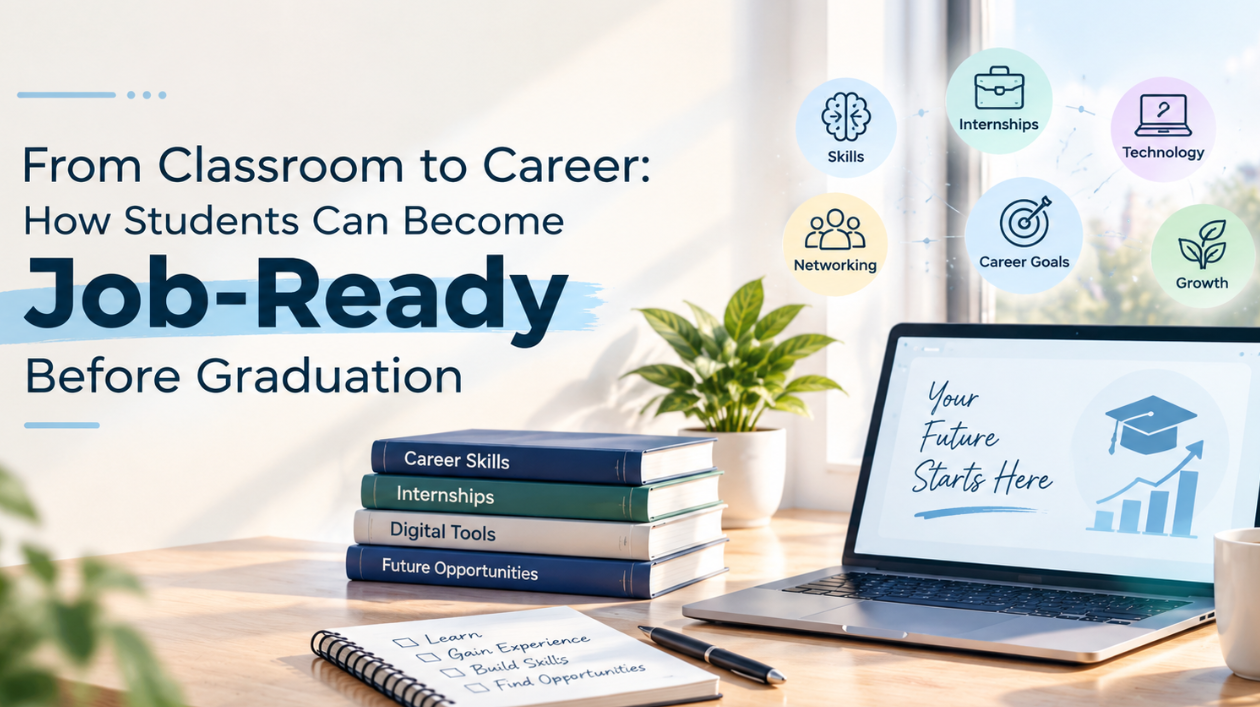
FROM CLASSROOM TO CAREER : HOW STUDENTS CAN BECOME JOB-READY BEFORE GRADUATION
Getting a university degree is an important step toward building a career, but graduation alone does not always prepare students for the workplace.
Employers often look for more than academic qualifications. Communication, problem-solving, technical knowledge, teamwork, practical experience, and the ability to adapt can all help students transition from university to professional life.
The good news is that students do not have to wait until graduation to start preparing for a career. By developing the right skills and gaining practical experience during university, students can become more confident and better prepared for the job market.
1. Develop Skills Alongside Your Degree
University courses provide students with knowledge in their chosen field, but students should also develop practical skills that can be used outside the classroom.
For example, a computer science student can learn programming languages and software tools, while a business student can develop skills in data analysis, digital marketing, or financial modelling.
Students should identify the skills commonly required in their desired career and start developing them during their degree.
2. Gain Practical Experience
One of the best ways to become job-ready is to gain experience before graduation.
Internships, part-time jobs, freelance work, volunteer opportunities, university projects, and competitions can help students understand how their knowledge is applied in real situations.
Even a small project can become valuable experience. A student studying graphic design could create a portfolio of designs, while a computer science student could build a website or application.
Practical experience can also help students discover what type of work they enjoy before entering the full-time job market.
3. Build a Strong Student CV
Students should not wait until their final semester to create a CV.
A student CV can include academic achievements, projects, internships, certifications, volunteer work, competitions, technical skills, and relevant extracurricular activities.
The goal is not to make the CV as long as possible. Instead, students should focus on including experiences and skills that are relevant to the opportunities they want.
4. Create a Portfolio
A portfolio can help students demonstrate what they can actually do.
Students in creative and technical fields can especially benefit from having a collection of their work. However, portfolios are not limited to designers and programmers.
A student can include research projects, business plans, writing samples, marketing campaigns, presentations, websites, photography, data projects, or other relevant work.
A good portfolio gives employers something concrete to look at instead of relying only on a list of qualifications.
5. Improve Communication Skills
Technical knowledge is important, but students also need to know how to communicate their ideas.
Communication skills can help students during interviews, presentations, meetings, teamwork, and everyday workplace situations.
Students can improve these skills by participating in presentations, group projects, student societies, debates, workshops, or other activities that require them to express their ideas clearly.
6. Learn How to Use Modern Technology
Technology is now part of almost every profession. Students should therefore become comfortable with the digital tools commonly used in their field.
Artificial intelligence is also becoming increasingly relevant across different industries. Students can learn how AI tools can support research, productivity, analysis, writing, design, or other professional tasks while still developing their own judgment and skills.
7. Start Networking Before Graduation
Networking does not have to mean asking people for jobs.
Students can start by connecting with teachers, alumni, professionals, internship supervisors, classmates, and people working in industries they are interested in.
Building professional relationships early can help students discover opportunities and better understand what employers expect from graduates.
8. Prepare for the Job Search Early
Waiting until graduation to think about employment can make the transition more stressful.
Students can start exploring job descriptions during university to understand which skills and qualifications employers commonly request. They can then work on developing those skills before graduation.
Students can start with small steps: learn a new skill, complete a project, apply for an internship, improve their CV, build a portfolio, or attend a professional event.
A university degree provides an important academic foundation, but the experiences and skills students develop alongside their studies can help them make the transition from classroom to career with greater confidence.
Start preparing before graduation, and you won't have to start preparing for your career after it.