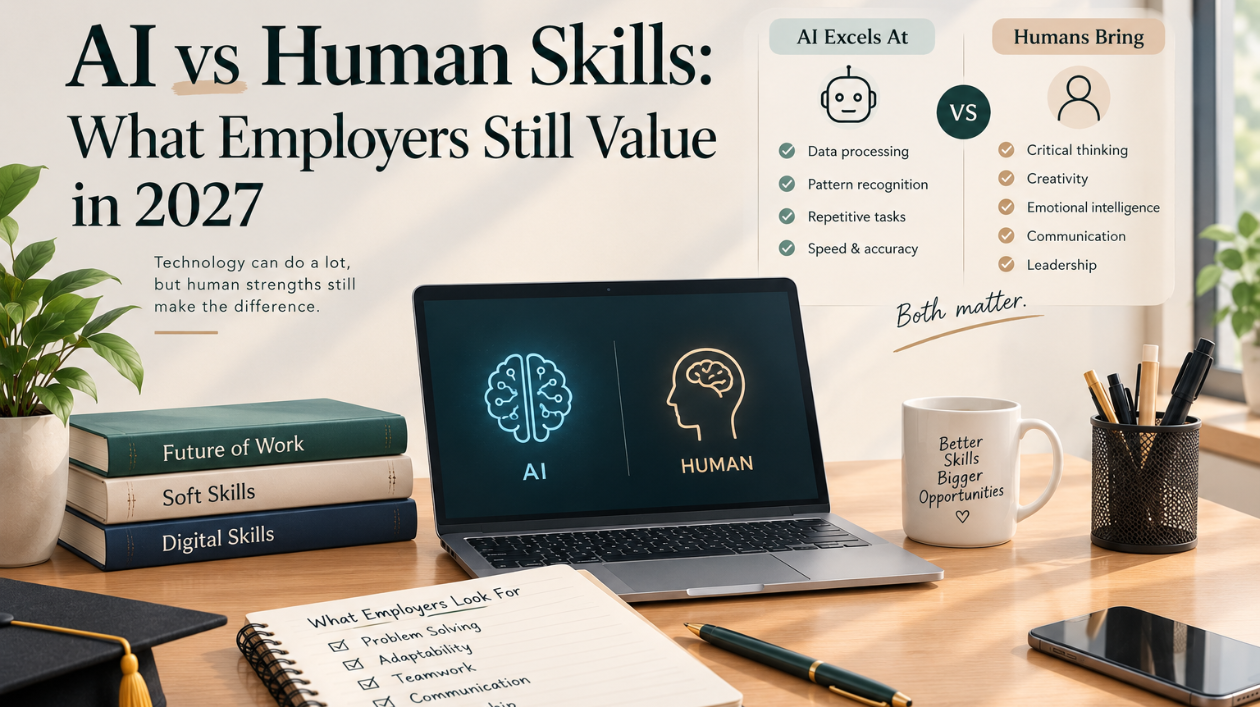
Every student today asks the same question: will AI take my job before I even get one? It is a fair worry. AI tools can now write, code, summarise and analyse in seconds. But the research also shows something more encouraging. Employers are not looking for people who compete with AI. They are looking for people who combine sound human judgment with the smart use of AI.
This guide explains what AI does well, what humans still do better, what employers are actually asking for as we head into 2027, and how Pakistani students can prepare.
The Short Answer
It is not AI versus humans. It is people who use AI well versus people who do not. The skills that matter most in the coming years fall into two groups: human skills that AI cannot easily replace, and AI skills that make you faster and more valuable at work. Students who build both will have the strongest position.
What AI Does Well and What Humans Still Do Better
AI is strong at:
- Drafting text, summaries and first versions quickly
- Processing large amounts of data and spotting patterns
- Handling repetitive, rule-based tasks
- Generating code, translations and basic designs
Humans are still stronger at:
- Judging what is true, relevant and appropriate in a real situation
- Building trust and communicating with clients, teammates and customers
- Understanding emotions, culture and context
- Making ethical decisions and taking responsibility for outcomes
- Thinking creatively about problems that have no clear precedent
AI is improving quickly, so this line will keep moving. That is exactly why adaptability is one of the most valuable skills you can build.
What the Research Says
The World Economic Forum's Future of Jobs Report 2025, which surveyed more than 1,000 large employers, found that analytical thinking is the most sought-after core skill, with seven out of ten companies calling it essential. It is followed by resilience, flexibility and agility, and by leadership and social influence. AI and big data are the fastest-growing skills, and creative thinking, curiosity and lifelong learning are also rising in importance. Employers expect about 39 percent of key job skills to change by 2030.
NACE's Job Outlook 2026 tells a similar story for new graduates. When employers review resumes for entry-level roles, they look for evidence of teamwork, problem-solving and communication, and AI is increasingly becoming an expectation for early-career candidates. Around 70 percent of employers report using skills-based hiring.
The entry-level picture needs honesty, though. A Stanford Digital Economy Lab study, updated in August 2026, found that employment among 22 to 25-year-olds in highly AI-exposed occupations is about 19 percent below where it would have been compared with similar young workers in less-exposed jobs. The researchers also found no widespread, economy-wide job displacement, and the declines are concentrated in occupations where AI mostly substitutes for human tasks. Where AI mostly complements workers, employment is flat or rising. These are US findings and the authors describe them as early indicators rather than proof of cause, but the message for students is clear: routine tasks are the most exposed, and skills that combine judgment with AI are the safest.
Human Skills Employers Still Value
1. Analytical and critical thinking
This is the ability to question information, compare options and reach a well-reasoned conclusion. AI can produce an answer, but someone has to decide whether it is right. Build this skill by explaining your reasoning in writing, checking sources, and solving case studies.
2. Communication
Clear writing, confident speaking and good listening remain essential in every industry. Practise by presenting projects, writing short reports, and explaining technical ideas to non-technical people.
3. Creativity and original thinking
Employers value people who bring new ideas, not just polished copies of existing ones. Use AI to brainstorm, but add your own perspective, examples and local context.
4. Adaptability and continuous learning
Since skills are changing quickly, the ability to learn new tools and unlearn old habits is a career advantage. Set aside a few hours each week to learn something new and apply it.
5. Teamwork and emotional intelligence
Working well with others, handling disagreement, and understanding what clients or colleagues need cannot be automated. Group projects, societies and volunteering are excellent training grounds.
6. Leadership and initiative
Leadership does not require a title. Organising an event, leading a project or taking responsibility for a problem counts as evidence.
7. Ethics, accountability and judgment
Employers need people who can decide when AI output should not be trusted, protect sensitive information, and take responsibility for their work.
AI Skills Employers Now Expect
- Using AI tools effectively for research, drafting, analysis and organisation
- Writing clear prompts and improving outputs through follow-up instructions
- Verifying AI output for accuracy, bias and errors before using it
- Basic data literacy, such as reading charts, cleaning data and drawing conclusions
- Knowing where AI should not be used, such as confidential or sensitive work
Most employers see AI as a tool that supports workers rather than replaces them, so showing that you can use it responsibly is a real advantage.
The Winning Combination: Human Judgment plus AI
A student who uses AI to produce a first draft in ten minutes, then improves it with research, examples, correct facts and their own voice, is more valuable than one who copies AI output without thinking, and more efficient than one who refuses to use it at all. The formula is simple: let AI handle speed, and let your judgment handle quality.
What This Means for Pakistani Students
Pakistan's graduate job market is already competitive. Gallup Pakistan's analysis of the Labour Force Survey 2024-25 shows that unemployment among graduates aged 20 to 24 is 32.8 percent, almost one in three. A 2025 study cited by Pakistan Education Review found that 72 percent of employers were dissatisfied with graduates' work-readiness, with gaps in practical experience, digital literacy and soft skills rather than subject knowledge.
That is useful information, because these are all skills you can build. A degree alone is not enough, but a student who can communicate clearly, solve problems, use AI responsibly and show real projects stands out. Free programmes such as DigiSkills, NAVTTC and HEC's Coursera licences can help you build the practical side without spending money.
How to Show These Skills to Employers
- Tell problem-solving stories. Employers say the best way to demonstrate skills in interviews is to share examples of situations where you used them to solve a problem. Prepare three short stories using the situation, your action and the result.
- Build AI-assisted projects and explain your role. In your portfolio, describe what AI helped with and what you decided, corrected or improved yourself.
- Gain real experience. Internships, freelance work and volunteering matter. In NACE's 2026 spring data, as reported by career centres, graduates with internships or co-ops were hired at a far higher rate than those without work experience.
- Collect proof of teamwork and leadership. Society roles, events, group projects and competitions all count.
- Keep your profile active. Update LinkedIn with projects, skills and short posts about what you are learning.
Mistakes to Avoid
- Copying AI output without checking it. Errors and made-up facts can damage your credibility.
- Hiding that you use AI. Be transparent and follow your university's and employer's policies.
- Ignoring soft skills. Technical ability alone rarely wins a job, especially at entry level.
- Chasing every new tool. Learn a few tools well and focus on solving real problems.
- Waiting until graduation. Start building experience and projects now.
Frequently Asked Questions
Will AI replace entry-level jobs?
AI is affecting some entry-level work, especially routine tasks that it can automate, but research so far shows uneven effects rather than widespread displacement. Students who develop judgment, communication and AI skills are in a stronger position.
Do I need to learn coding to work with AI?
Not necessarily. Many roles need AI literacy, good prompting and critical evaluation rather than programming. Coding helps for technical careers, but it is not required for everyone.
Which skills should I learn first?
Start with communication and critical thinking, then add one practical digital skill in your field and basic AI tool skills.
Are certificates still useful?
Yes, especially as a structured way to learn, but employers care more about what you can show, such as projects and results.
Final Thoughts
AI is changing how work gets done, but it is not making people unnecessary. Employers still need people who can think clearly, communicate well, learn quickly and take responsibility. The students who combine those human strengths with confident, careful use of AI will be well prepared for 2027 and beyond.
---